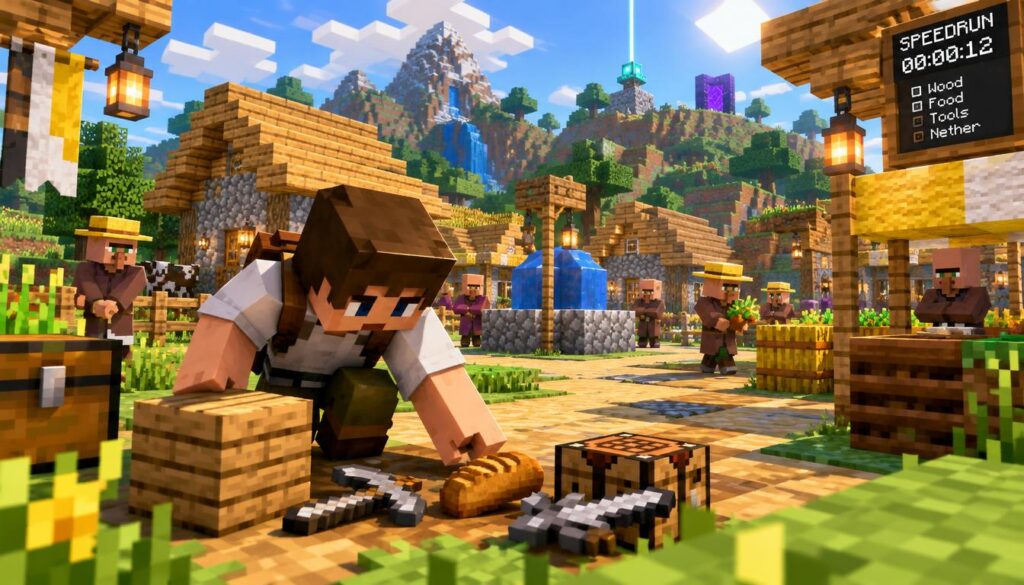
A fast Minecraft finish is less about collecting everything and more about making a few good decisions in the right order. RSG, or random-seed glitchless, is a speedrun category that starts in a new random world and does not allow glitches.
This guide focuses mainly on a standard glitchless Any% route, where we aim to defeat the Ender Dragon. Speed and rules depend on the category, so we should choose one before judging our time.
New runners usually need practice before their route feels smooth. Luck affects each world, and even a strong plan may change when useful supplies are far from spawn.
We will focus on choices that keep a run moving, rather than treating every world like a full survival game. A first run is useful practice even when a poor spawn prevents a personal best.
Key Takeaways
- Choose one speedrun category before comparing times.
- Learn the main route, then adjust it to fit each world.
- Keep only the supplies needed for survival and progress.
- Use practice runs to spot one clear improvement at a time.
- Record a finished run so we can review our choices.
What Counts as a Valid Minecraft Speedrun?
In the standard format, the clock runs from world load until the Ender Dragon dies. A valid time depends on the category’s seed and glitch rules, not just the finish.
In RSG, we start in a random new world and adapt our route without using glitches. In SSG, or fixed-seed glitchless, we use a known world and can prepare a route.
The standard world-load timing rule gives runners a shared start and finish. Other categories change the goal or allow different tools and tactics.
| Category | Seed | Glitches allowed | Key rule |
|---|---|---|---|
| RSG | Random new world | No | Adapt the route to the world |
| SSG | Fixed, known world | No | Prepare a route for the seed |
| Random Seed Glitched | Random new world | Yes | Glitches are allowed |
| Hardcore Any% | Random new world | Category rules apply | Death ends the attempt |
All Advancements has a different goal from a dragon finish: we must unlock every advancement. That can take hours for most players, so it is not the same kind of short Any% run.
Category labels matter when we compare results or prepare a recording. A time from a glitched run cannot stand in for a glitchless result.
Some categories also use different game rules or submission checks. The category page sets the exact rules for each leaderboard, including what counts as an allowed action.
We should learn those rules before starting an attempt, not after finishing one. Confirm the category before comparing times, since a seed or glitch rule can change what counts as a valid finish.
Can a Minecraft Speedrun Guide 2026: How to Beat the Game Fast Work for Beginners?
Beginners should usually start with RSG if they want to learn how to make decisions in a fresh world. RSG practice teaches us to change plans when terrain or loot changes.
A new world may offer a quick village, a useful lava pool, or none of those near spawn. We learn to judge what we have and keep moving.
How RSG balances speed and adaptation
RSG is useful practice because every run asks us to read a different world. We can review why we chose one route over another, even when the finish was slow.
Elite RSG runs could finish in under 20 minutes in 2025. That is a benchmark for highly practiced runners, not a promise for a first attempt.
Early runs may take much longer because we are learning movement, crafting, and route choices at once. We can track progress by noting where a familiar task gets faster.
When a prepared SSG route fits better
SSG suits a runner who wants to memorize a known world and rehearse a set path. A fixed seed can make practice more repeatable than random terrain.
Elite SSG runs could finish in less than 10 minutes in 2025. That speed comes from preparation and does not mean SSG is easier for every beginner.
All Advancements is a longer goal than Any% because we must unlock every advancement. In the 2025 guide, most players needed hours to complete it.
We should choose based on the skill we want to practice, not only the shortest record. Pick one category for a practice session so that route improvements are comparable from run to run.
Which Timer and Settings Make Practice More Consistent?
A visible timer and readable in-game cues make it easier to tell whether a practice change actually helped. We should keep the setup stable before changing route choices.
LiveSplit is a commonly used speedrun timer. Subtitles can also reveal sounds from lava or nearby mobs, which may help us react sooner.
Set up the timer and useful accessibility options
We can turn Show Subtitles on and Auto-Jump off. Subtitles make some nearby sounds easier to notice, while manual jumping gives us direct control.
V-Sync can add delay or limit frame output. Turning it off and matching the FPS limit to the display can help keep movement consistent.
| Setting or tool | Recommended choice | Practical role |
|---|---|---|
| LiveSplit | Use a visible timer | Track practice segments |
| Show Subtitles | On | Spot lava and nearby mobs |
| Auto-Jump | Off | Control jumps by hand |
| V-Sync/FPS limit | V-Sync off; match display FPS | Keep frame output steady |
| Performance mods | Sodium and Lithium; one lighting mod | Improve performance and reduce stutters |
Add performance mods carefully
Sodium can improve performance and reduce micro-stutters. Lithium optimizes game and server logic, which may help the game run more smoothly.
Starlight and Phosphor are incompatible, so we should use only one. Check game version, mod loader, and dependencies before adding tools; a mod compatibility check helps avoid install conflicts.
Performance mods cannot teach a route or fix a poor decision. Change one setting at a time so a new performance problem is not mistaken for a routing mistake.
What Does the Standard Any% Route Require?
The standard RSG path is a chain of four objectives, not a full survival-game checklist. We need supplies, blaze rods, ender pearls, and a route to the End.
World conditions can change the order of useful tasks. A runner may collect items in a different order when a detour saves time or solves a problem.
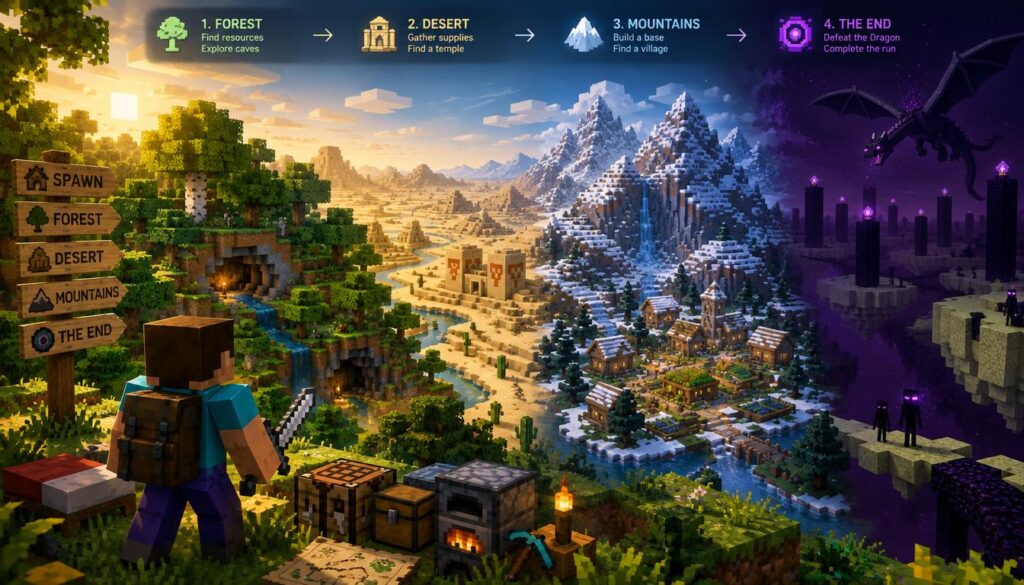
- Overworld supplies and portal: gather key items and reach a Nether portal.
- Nether blaze rods and pearls: collect materials needed for Eyes of Ender.
- Stronghold and End portal: locate the structure and enter the End.
- Ender Dragon fight: defeat the dragon to finish the run.
The first phase should cover only what we need to reach the next objective. Extra mining can add time without making the route safer or faster.
In the Nether, blaze rods support progression, while ender pearls help us make Eyes of Ender. We should treat both as route items, not as a reason to collect every resource nearby.
After locating the stronghold, our goal shifts from travel to finding its portal room. Once inside the End, the route becomes a focused fight rather than more exploration.
The four phases are a decision framework, not a rigid script. Leave optional mining and extra armor behind when they do not solve a survival problem or unlock the next objective.
Which Overworld Loot Is Worth the Detour?
A nearby village can turn food and iron into a fast start without a long mining trip. Take the detour when its supplies solve an immediate route need.
Hay bales can become wheat and bread, and iron golems can provide iron. A village can also supply beds for use later in the run.
Prioritize village supplies
A village offers several useful items in one place, but we should take only what helps. Iron can support basic tools, while food keeps travel from becoming risky.
We can craft hay bales into wheat, then use the wheat to make bread. Beds are worth collecting when they fit our route and inventory space.
Check shipwrecks and ruined portals selectively
Shipwrecks and ruined portals may offer useful loot, but their value depends on what we still need. We should check a nearby chest when it is easy to reach.
Clearing every chest is a common time loss when only one missing resource blocks progress. A long search for extra gold or iron can cost more than it gives.
- Hay bales for food: turn the wheat into bread.
- Iron golem for iron: collect iron when tools or gear need it.
- Beds for the End: take beds that fit our planned route.
- Shipwreck or ruined-portal loot: check for a useful missing item.
Distance matters as much as the chest contents. A structure across rough terrain may not repay the time spent reaching it.
We can leave once the useful supplies are in hand, even if containers remain unopened. Leave a structure as soon as its useful supplies no longer justify the extra travel.
How Can We Build a Nether Portal Without Mining Obsidian?
If lava and water are available, we can form a portal frame without first mining 10 obsidian blocks. A standard Nether portal frame uses 10 obsidian, but a lava-and-water build avoids mining it.
This method can save a mining trip when we find a usable lava source. It still takes practice, since one misplaced water flow can turn the intended frame into cobblestone.
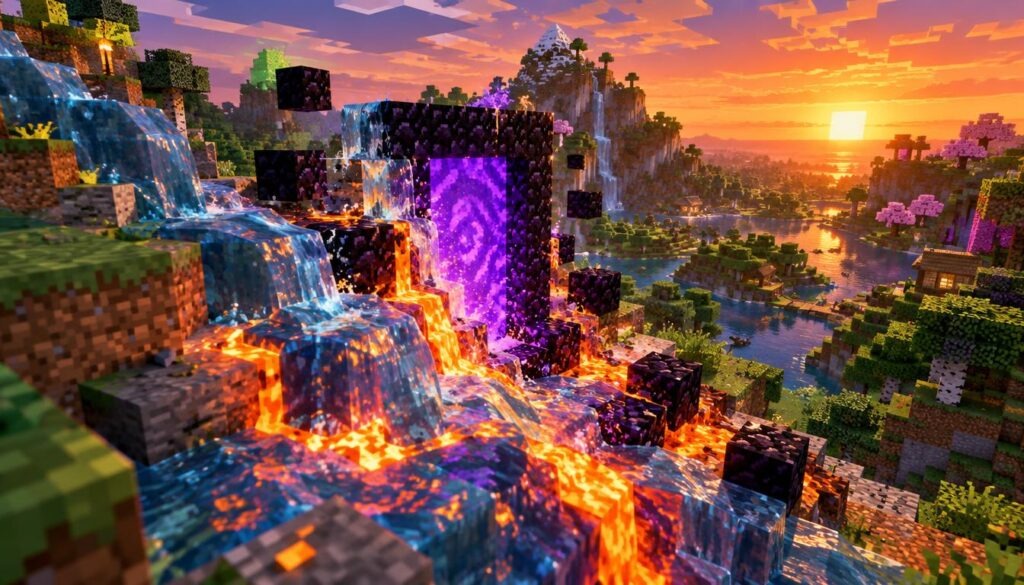
We should learn the build in a low-pressure world before trusting it during a serious run. A failed frame can cost time and leave us short on supplies.
- Locate a usable lava source with room to work.
- Arrange water and lava to form the portal frame.
- Light the finished portal.
- Enter with the supplies needed for the next objective.
Mining 10 obsidian is another way to make the frame, but it can take longer when we lack the right tools. A bucket-based build skips that mining step.
Position matters: water placed across the wrong lava blocks can create cobblestone instead of the frame. We should test each placement until the sequence feels familiar.
Keep the build simple and avoid extra blocks that do not help form the portal. Practice the water placement in a low-pressure world before relying on it in a record attempt.
How Do We Find a Fortress and Collect Blaze Rods?
The fortress objective is to reach a blaze spawner and leave with enough rods, not to clear the whole structure. Focus on the spawner, then make a safe exit with the blaze rods.
Blazes are commonly defeated at a fortress to obtain blaze rods. The spawner is the main target, while side rooms and chests can add risk without helping the route.
Search for a fortress efficiently
Move through the Nether with a clear search direction and watch for fortress bridges and walls. Do not spend time exploring every hallway once we have found a route toward blazes.
A fortress may have several paths, so we should keep track of our entry point. That makes it easier to leave without circling through explored rooms.
Fight blazes with a safe exit in mind
At a blaze spawner, use cover when the area allows it. A shield can help when our equipment permits, and snowballs can damage blazes from a distance.
| Objective | Place or target | Useful action | Main risk |
|---|---|---|---|
| Fortress search | Nether fortress | Follow bridges toward blaze areas | Lost time in side rooms |
| Blaze-spawner fight | Blaze spawner | Use cover or snowballs | Blaze fire and damage |
| Retreat with rods | Known exit route | Leave after needed rods | More fights on the way out |
We should avoid fighting every blaze if the route goal is already met. Extra combat may drain health and make the return harder.
Before moving toward the spawner, note a path back through the fortress. Collect the needed rods before taking an optional fight that adds no route value.
How Can Gold Trades Supply Ender Pearls?
Piglin bartering turns gold into a chance at the ender pearls needed for the route. Trade gold ingots with piglins when we have enough gold and a safe place to manage them.
Gold ingots are the trade item, and piglin trades are a common way to get pearls in RSG. The returns can vary, so we should count each pearl rather than guess.
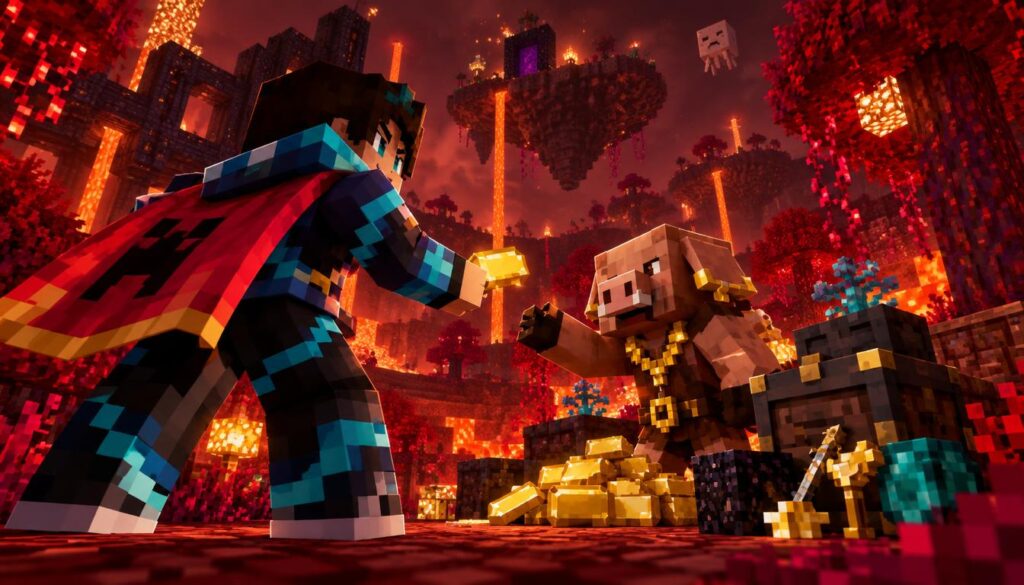
Trade gold with piglins
We can drop or hand over gold ingots, then collect the items piglins return. Keep the trade area controlled so we can track the results without losing the items.
Gold blocks may look like easy trade supplies, but they are not automatic bartering choices. We should consider whether gold is more useful for another movement or survival need.
Trading takes available gold and a safe spot to manage piglins. If either is missing, forcing the trade route can add risk without giving us a clear advantage.
Use endermen when a trade route is poor
Endermen can also provide pearls in the Overworld or Nether. Hunting them is an alternative when we have little gold or piglin trades have not helped.
The best choice depends on what the world gives us. A nearby enderman may be faster than seeking more gold, while a ready trade area may make bartering simpler.
We should avoid splitting attention between two methods without a reason. Choose the option that addresses the pearl shortage with less travel and danger.
Keep track of the pearls as they arrive, then stop when the route has enough. Stop trading when the pearl count is sufficient and more gold is better saved for movement or survival needs.
How Do We Locate the Stronghold with Eyes of Ender?
An Eye of Ender gives us a direction, while a second throw helps narrow down where the stronghold lies. Record the first direction and coordinates before moving for another check.
We can use two Eyes of Ender thrown about 17.5 blocks apart to triangulate a stronghold. The second direction helps us estimate where the paths cross.
Follow the first Eye of Ender
Throw an eye and watch which way it travels. That gives us a direction to follow, though it does not mark the stronghold’s exact entrance.
Before walking on, note our coordinates and the eye’s path. A clear record gives us a useful starting point for the second check.
Narrow the location with triangulation
Move sideways from the first trajectory before throwing again. The two directions can help estimate the stronghold’s location and reduce aimless travel.
- Throw the first Eye of Ender.
- Note the direction and coordinates.
- Move about 17.5 blocks perpendicular to the first trajectory.
- Throw again to estimate the stronghold location.
Eyes can break when thrown, so we should carry a small reserve. Do not plan to use every eye for travel if we also need them for the End portal.
A direction check can still be useful if we move carefully and keep notes. Record the coordinates before digging so a missed approach does not erase the best location clue.
How Do We Find the End Portal Room?
Once we reach the stronghold, the goal is to find the portal room, not to explore every room. Mark explored branches so we do not search the same corridor twice.
Use a simple search pattern through open corridors and side passages. Place blocks or torches at turns to show which branches we have already checked.
Listen for silverfish sounds as we move. Subtitles can help locate silverfish near the portal room, giving us a useful sound cue in the maze.
The End portal frame has 12 slots. Check how many already hold Eyes of Ender before using the remaining supply.
We should track each explored hallway rather than relying on memory alone. Similar stone corridors can look alike, especially after we have made several turns.
When a branch ends, return to the marker and choose an unexplored path. This keeps the search moving without forcing us to map every room.
Wandering through the same corridor twice without leaving a marker wastes time and can make us lose our direction. Count the empty frame slots before placing the last Eyes of Ender.
How Do We Defeat the Ender Dragon Quickly?
A fast dragon finish depends on arriving prepared and using bed explosions at the right moment. Beds explode in the End, so careful timing matters as much as damage.
Four beds are enough to defeat the Ender Dragon without destroying the End crystals. Bed explosions can deal heavy damage, but a rushed placement can hurt us too.
Prepare for the End fight
Bring supplies that support movement and survival, along with a way to deal with crystals. The fight is harder when we enter without food or tools for quick repositioning.
- Food to restore hunger during the fight.
- A water bucket for movement and emergency control.
- Blocks for climbing or reaching useful positions.
- A weapon or projectiles for the End crystals.
Golden apples are an optional recovery tool, not a required speedrun item. Each golden apple uses one apple and eight gold ingots, so we should weigh that cost against the route.
Use beds carefully during the perch
Wait for a useful dragon perch before placing a bed. The explosion must hit the dragon while we stay far enough away to avoid taking the blast ourselves.
Plan where to stand and how to trigger the bed before the dragon arrives. A controlled setup is safer than placing beds in a rush beneath the dragon.
We can use the crystals or other attacks if the fight demands it, but the bed method can avoid destroying the crystals. The key is keeping our position and timing in mind.
After each explosion, check our health and the dragon’s position before acting again. Keep the bed placement controlled, since a rushed explosion can damage the runner as well as the dragon.
What Should We Do When a Seed or Attempt Goes Bad?
Reset when the seed removes a necessary route option, not just because the opening is imperfect. A recoverable mistake is a reason to adapt, not an automatic reset.
A world with no workable route may justify starting again. A missed jump or a slow first choice may still leave enough supplies and time to continue.
Reset when the route is clearly blocked
We can use a simple single-instance setup and reset by hand while learning. That keeps the process easy to understand and limits extra software.
Atum provides an automatic reset option. FastReset disables the forced autosave on exit, while multi-instance setups can run 2-4 instances, depending on hardware.
More open instances use more system resources. A computer that runs several worlds poorly may make practice less stable, so we should match the setup to our hardware.
Practice before adding reset complexity
Learn the basic route before installing several reset tools. Too many tools can make it harder to tell which action starts, saves, or abandons a world.
We should also separate a bad seed from a poor decision. A missing route option may block progress, while a recoverable error can teach us how to adjust.
Reset rules can differ by category and leaderboard. Keep reset tools within the rules of the category and leaderboard you plan to submit to.
What Evidence Does a Speedrun Submission Need?
A completed run needs a recording that lets reviewers verify both the gameplay and the category rules. Record the full attempt with game audio and the timer visible.
Submissions need the game version, category details, and seed information when the category calls for it. Moderators review attempts before publishing them on a leaderboard.
| Evidence item | What the video should show | Why it matters |
|---|---|---|
| Full run footage | Attempt from start through finish | Shows the run was continuous |
| Game audio and timer | Audio is audible; timer stays visible | Helps check play and time |
| Version, seed, category details | Relevant settings and world details | Confirms the rules for the category |
Seed details matter only when the category requires them. The category name should be clear, since reviewers need to know which rules apply to the attempt.
Check that the recording covers the full run and that the timer does not disappear during play. The game audio should remain clear enough to hear the session.
Moderators review submissions before leaderboard publication, so a finished attempt does not appear at once. A clear recording makes it easier to check the run against its category.
Keep the file intact until the review is complete, and make sure key details can be read. Check the entire recording before submission to make sure the timer and game audio remain visible and audible.
Why Do Some Minecraft Speedrun Times Look Impossible?
A sub-20-second display can describe a tool-assisted, heavily glitched result rather than a conventional run. We should compare times only when their category and timing method match.
A 2023 post described a Minecraft TAS just under 20 seconds, using in-game timing, a set seed, and heavy glitches. A TAS is a tool-assisted speedrun, not a standard glitchless attempt.
Separate tool-assisted results from standard runs
Some unusually short displays rely on rules that standard RSG does not allow. A set seed and heavy glitches make that result different from a fresh random world.
Two faster in-game-timed runs took 52 minutes and 35 minutes in real time. Time-travel glitches can pause the in-game clock while real time passes.
That gap shows why a timer alone may not tell us how long a player spent. We need to know whether the display tracks game time or real elapsed time.
Compare records only within the same category
The Any% RSG record listed for July 27, 2026, was 6:39 by Skycrab. That is a category-specific result, not a universal record across versions and rules.
A record only makes sense beside its seed rules, glitch rules, version, and timing method. We should not compare a TAS display with a standard RSG finish as if they were the same challenge.
Times can also look different when one clock pauses and another keeps running. Compare a time only after confirming its category, seed rules, glitch rules, and timing method.
What Changes When We Speedrun Bedrock Edition?
Bedrock runners should first confirm the edition-specific category before copying a Java route. A Minecraft speedrun guide for Bedrock must check edition rules and rebuild Java-only navigation steps.
A village-based strategy is identified for Bedrock Edition. We should use route advice made for that edition rather than assume every Java tactic works the same way.
Check edition-specific categories first
Bedrock runs should be compared against Bedrock-specific categories and rules. Edition affects which tools and route methods apply to a valid submission.
Version details matter too, since a route built for one game version may not match another. We should check the category rules before recording a run.
Rebuild the route around Bedrock mechanics
The Nether fortress pie-chart method is for Java Edition only. It is not a universal instruction for finding a fortress in Bedrock.
On a mobile device, stable performance can matter during fast movement. These mobile lag fixes cover settings that can help reduce frame drops and heat.
We can keep the broad goal of gathering supplies and reaching the End, then adjust the steps to Bedrock. Verify the exact Bedrock rules and version before recording an attempt for a leaderboard.
Conclusion
Fast finishes come from practicing decisions as deliberately as movement. A consistent category and a rehearsed route make our progress easier to measure.
RSG still asks us to adapt when a world changes the plan. We can improve by reviewing one run and fixing one slow choice at a time.
Pick a category we intend to keep practicing, then record a session from start to finish. Start one practice session in the category you intend to run, record it, and note the first point where the route slowed.
FAQ
What are some tips and tricks for speedrunning in Minecraft?
Learn one category, practice its portal and crafting sequence, and review a recorded run to find one fix at a time. Focus on a single repeated task, such as building the portal, before trying to change the whole route. Keep notes on delays and mistakes. Small, clear changes make it easier to tell which practice choice helped.
Who beat Minecraft in 20 seconds?
A reported tool-assisted, set-seed, heavily glitched result finished just under 20 seconds by in-game timing. That example does not represent a standard glitchless run, and it should not be treated as an ordinary player’s time. Tool-assisted play can use precise inputs and glitches that standard categories ban. A category and timing method matter when we compare results.
Is Minecraft easy to speedrun?
Minecraft is easy to start speedrunning, but difficult to optimize. Elite RSG runs could finish in under 20 minutes in 2025, while beginners usually took longer. A new runner must learn movement, resource choices, and route changes across random worlds. Practice can make those choices quicker, but world luck still affects each attempt.
Who is the #1 Minecraft speedrun?
Skycrab’s 6:39 Any% RSG result was listed for July 27, 2026. That result applies to its category and rules, not every Minecraft speedrun. Rankings can differ by category and game version, including whether glitches or fixed seeds are allowed. We should compare results on the same leaderboard before calling one runner number one.
Who beat Minecraft in 17 seconds?
A standard 17-second Minecraft finish is not established by the reported example. The known just-under-20-second result was a tool-assisted run on a set seed with heavy glitches and in-game timing. That is different from a normal glitchless run. A displayed time can also mislead when a glitch pauses the in-game clock.
How fast can a normal person beat Minecraft?
Beginners usually take longer than the elite RSG benchmark of under 20 minutes. Practice, route choices, and the world itself affect the result, so a first finish may take much longer. We can make progress by learning one category and reviewing each attempt. A personal best is a better early goal than matching an elite time.