
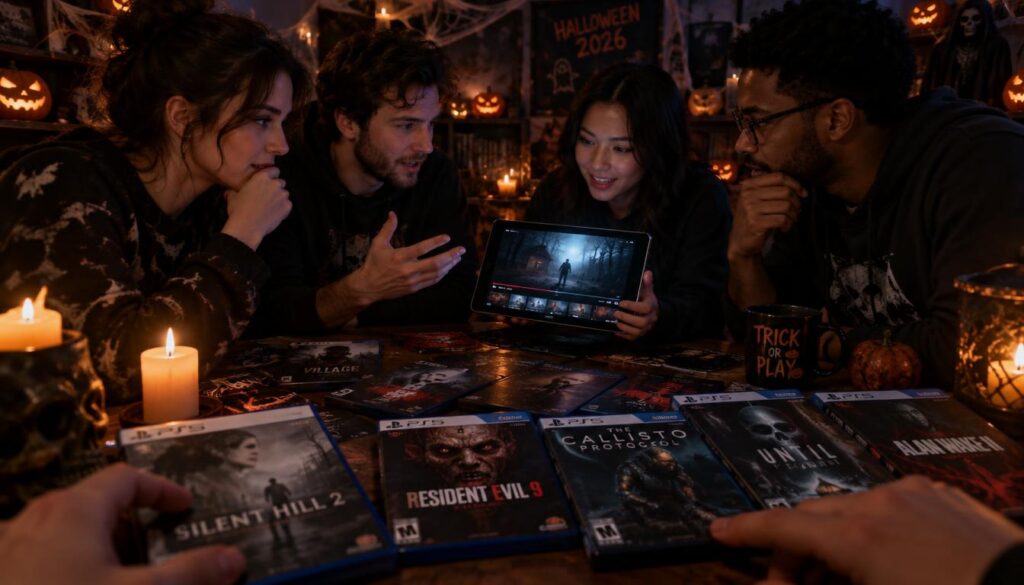
Playing alone in the dark can make every creak feel personal, while a room full of friends can turn scares into laughter. For Halloween 2026, your best pick depends on whether you want a solo scare, a story-led game, survival pressure, or shared play.
Scare factor is a subjective guide to how intensely a game uses tension, disturbing imagery, pursuit, or sudden scares. It helps you compare the feel of games, but it cannot predict how you will react. This shortlist makes practical distinctions instead of naming one universal winner.
Some players want a slow mystery, while others want a threat at their heels. Your available time, comfort with disturbing scenes, and preferred way to play all matter. A high scare factor does not automatically mean a better experience.
Start with the quick comparison, then use the selection tips to match a game to your mood and plans. That way, your Halloween scares fit the night you actually want.
Key Takeaways
- Choose by scare style, not just by score.
- Check content descriptors as well as age ratings.
- Co-op can ease fear or add stressful teamwork.
- Confirm your platform and edition before choosing.
- Pick a game that fits your group and available time.
How Can You Quickly Compare Horror Games?
The fastest shortlist starts with your preferred scare style, not the highest score. Scare factor is a subjective editorial guide, not a standard rating shared by every game or reviewer.
A lower number does not mean a game lacks atmosphere or story. The scale here gives you a quick sense of how strongly each title leans on tension, pursuit, disturbing images, or sudden scares.
| Game | Release year | Scare factor |
|---|---|---|
| Alan Wake 2 | 2023 | 6 |
| Alien: Isolation | 2014 | 9 |
| Amnesia: The Bunker | 2023 | 9 |
| Dead Space (2023) | 2023 | 8 |
| Until Dawn | 2015 | 8 |
Think of the numbers as a starting point, not a verdict. A six may suit you if you want dread and a strong story without constant pursuit. A nine may fit if being hunted is part of the appeal.
The horror games ranked here also use different tools. One builds fear through a persistent enemy, while another relies more on plot, setting, or choices. Your taste can matter more than a two-point gap.
Use the quick view to narrow your options, then consider what you want from your Halloween play. The next comparison turns to new horror game releases in 2026.
Best Horror Games 2026: Scariest Games Worth Playing This Halloween
A major franchise return sits beside smaller games taking unusual genre risks. These horror games offer very different settings and play styles, so the right pick depends on what you want to face.
Exact launch dates are not supplied here, so these are described as 2026 games without assigning a day. The table focuses on each horror game’s premise and its clearest point of difference.
| Game | 2026 premise or setting | Distinguishing play feature |
|---|---|---|
| Resident Evil Requiem | Leon and Grace investigate deaths linked to Raccoon City survivors | Leon’s action sections contrast with Grace’s horror sections |
| The Sinking City 2 | Arkham faces a supernatural flood | More combat-oriented survival horror than its predecessor |
| Reanimal | Two small protagonists face grotesque creatures | Solo or co-op play |
| Silver Pines | Investigator Red Walker searches for musician Eddie Velvet in a monster-filled town | 2D metroidvania structure with survival-horror mechanics |
| The Mound: Omen of Cthulhu | Conquistadors seek a Lovecraftian lost city | Four-player co-op and visions that can cause mistaken attacks |
Resident Evil Requiem is the ninth mainline entry in the Resident Evil series. Its familiar world gains a new angle through newcomer Grace Ashcroft, whose horror-focused sections contrast with Leon Kennedy’s action-driven play.
The Sinking City 2 shifts its setting to flooded Arkham and takes a more combat-oriented survival-horror approach. Silver Pines pairs investigation with a 2D metroidvania structure, where you explore connected areas and face threats along the way.
Reanimal comes from Tarsier Studios, the developer behind Little Nightmares. Its two small protagonists face grotesque creatures, and you can play alone or with a friend. The Mound adds a risky group twist: player-specific visions can make teammates mistake one another for threats.
These horror game releases in 2026 cover distinct moods, from a known series to unusual new horror ideas. If you want shared scares, compare the co-op games by how their teamwork creates tension.
Which Co-Op Horror Games Are Best for Friends?
A teammate’s voice can suddenly become hard to locate when dark corridors split your group. Co-op horror games work best when your friends must communicate, but the game keeps that teamwork uncertain.
No one co-op game is objectively best for every group. Choose based on whether you want to avoid enemies, investigate together, or rely on careful stealth.
| Game | How the group plays | Source of tension |
|---|---|---|
| The Outlast Trials | Co-op for up to four or solo | Complete objectives while avoiding villains |
| Phasmophobia | Investigate haunted locations together | Voice recognition lets ghosts react to conversation |
| Lethal Company | Up to four players | Proximity chat and separation in dark corridors |
| The Blackout Club | Co-op stealth | Noise can expose the group |
Phasmophobia makes ordinary talk feel risky. Its voice recognition lets ghosts react to what players say, so a nervous joke may draw attention at the wrong moment.
Lethal Company uses proximity chat, which means a teammate’s voice fades as you move away. That small gap can turn a routine search into a tense choice: keep working or find your friends.
The Outlast Trials supports up to four players and also allows solo play. Your group completes objectives while avoiding villains. The Blackout Club takes a stealth approach, where a careless noise can put everyone in danger.
Friends may soften fear by joking, though proximity chat, voice-reactive threats, and stealth can make teamwork stressful again. Decide whether you want to stay close or risk separation, then turn to psychological horror for scares built around unease.
Which Psychological Horror Games Stay With You?
Getting lost in a town that looks almost familiar can feel more threatening than meeting an enemy. Psychological horror uses unease, mystery, and perception to unsettle you, rather than relying only on combat difficulty.
Hard fights alone do not make a game psychological horror. The genre’s pull comes from how a place, story, or character changes your sense of what is safe.
Silent Hill 2 Remake and the dread of a haunted town
Silent Hill 2 Remake is a 2024 survival-horror remake developed by Bloober Team. Its oppressive atmosphere makes the town feel hostile, while streets and rooms can seem hard to read as you explore.
That disorientation gives ordinary movement a tense edge. You may know where you are going, yet still feel unsure about what waits around the next turn. The story’s emotional weight adds another layer to that discomfort.
Signalis and the tension of never feeling safe
Signalis is a 2022 top-down 2D horror game developed by Rose-engine. It draws on classic survival-horror influences but builds a distinct pixel-art world with a persistent sense of dread.
Its view from above does not make the world feel distant. Instead, its mood and pressure keep you alert as you move through unfamiliar spaces. Psychological horror can work through what you fear might happen, not only what appears onscreen.
These games suit you if mystery and atmosphere matter more than nonstop action. If you want danger tied to scarce supplies and active threats, survival horror puts those pressures at the center.
Which Survival Horror Games Make Every Resource Count?
You are at a locked door, and a threat is still somewhere nearby. Survival horror makes each choice feel costly, especially when supplies run low and escape is uncertain.
These picks lean toward survival pressure rather than constant combat spectacle. You must weigh routes, resources, and risk instead of treating every threat as a target.
Resident Evil 2 Remake and the pressure of the police station
Capcom’s Resident Evil 2 (2019) follows Leon S. Kennedy through a labyrinthine police station. The layout makes backtracking part of the challenge, and Mr. X remains a persistent threat as you move between rooms.
A familiar hallway can feel different when you know a pursuer may be close. You must think about where to go and what to carry, not only how to fight. That pressure gives the station its dangerous feel.
Amnesia: The Bunker and an unpredictable pursuer
Frictional Games’ Amnesia: The Bunker is set during World War I. A monster hunts through the bunker, while changing objectives can force you to adjust your plans.
The threat makes a failed attempt matter. You cannot assume that the same route or tactic will stay safe, so each move asks for a fresh judgment.
The Mortuary Assistant offers a different kind of survival horror. The 2022 Darkstone Digital game turns embalming work into a tense routine, then adds supernatural disturbances that can change your sense of control.
Different endings and hidden secrets give you reasons to look closely at each shift. The game makes ordinary work unsettling, rather than framing every moment as a fight. These games suit players asking about the best action horror games, but their appeal comes from managing danger, not constant combat. Story-led games shift that pressure toward characters and choices.
Which Horror Games Put Story and Choices First?
You can watch a horror story unfold, or decide who gets through it. Story-led games give character choices, mystery, or unusual structure more weight than resource management.
Choose Alan Wake 2 for layered storytelling, or Until Dawn for choices that shape survival. Both put the people in the story near the center of the fear.
Alan Wake 2 and its dual-campaign structure
Remedy’s Alan Wake 2 arrived in 2023 with two campaigns. Its dual structure gives you more than one path through the story, and its plot takes turns without making every answer easy to predict.
The game also includes punishing boss battles. Those fights can raise the pressure, though the story’s twists and shifts remain a key part of its appeal. You can follow its mystery without knowing what comes next.
Until Dawn and choices with consequences
Supermassive’s Until Dawn is a 2015 slasher game built around a group of characters. Your choices can affect whether major characters survive, which makes small decisions feel tied to the group’s fate.
That setup can work well when friends watch and debate what to do. The story gives everyone something to discuss, while the consequences keep each choice meaningful.
Observation offers a slower alternative. This 2019 adventure game takes place on a space station and centers on a mystery, making it a fit if you prefer discovery to traditional survival-horror combat.
These horror games put the story and characters first, though they use different paces and structures. If you want the setting itself to feel hostile, sci-fi horror makes isolation part of the threat.
Which Sci-Fi Horror Games Make the Setting a Threat?
You are alone on a station, and the walls offer no real protection. Sci-fi horror turns distance and isolation into pressure, especially when creatures and failing surroundings limit your choices.
Space horror is not automatically action-heavy. Vulnerability and isolation can drive the fear just as strongly as combat.
Alien: Isolation and the hunt on Sevastopol
Creative Assembly’s Alien: Isolation came out in 2014 and takes place 15 years after the 1978 Alien film. You follow Amanda Ripley on Sevastopol, where a Xenomorph hunts through the station.
The creature is not the only danger. Sevastopol’s other threats and enclosed spaces make survival a constant concern. You must treat the station as a place to navigate carefully, not a safe base.
Dead Space (2023) and terror in deep space
EA Motive rebuilt Dead Space (2023) from the ground up as a remake of the 2008 game. It places you in the vacuum of space, where Necromorphs make the setting feel even less secure.
The cold emptiness around the action matters. A hostile creature is frightening, but the sense of being cut off can make each encounter feel more exposed.
Both sci-fi horror games use their settings to create danger. Alien: Isolation draws on a long hunt through a station, while Dead Space gives its remake a stark, isolated world.
Pick this style if distant, unfamiliar places appeal more than a familiar town or home. Smaller independent horror games offer another change of scale, often built around a single unusual idea.
Which Underrated Indie Horror Games Deserve a Chance?
A tightly focused one-person project can feel very different from a familiar blockbuster. Indie horror often uses a clear idea to create unease without relying on a large franchise name.
These picks stand out for their approach, not for any sales or popularity ranking. Try them if you want a less familiar horror game experience.
Tooth and Claw’s library of short experimental scares
Tooth and Claw is the one-person studio of Dan McGrath, whose horror games include Incident at Grove Lake. That title is a concrete place to start if you want a compact, experimental scare.
Short projects can make their ideas easy to grasp. Instead of stretching one premise across a long game, they can focus your attention on a specific setting or unsettling event.
Sylvio 2 and recorded hauntings
Stroboskop’s Sylvio 2 is a 2017 PC game about a ghost hunter searching audio and video recordings for spirits. The recordings give you a reason to listen and look closely, which can make the act of investigation feel tense.
You are not simply waiting for a ghost to appear. The fear grows as you examine what a recording might contain and decide what it means.
The Complex: Expedition is a 2023 PC liminal-space horror game developed by pgWave. Its story uses disorientation and dread, turning strange, empty spaces into the focus rather than a familiar monster hunt.
These indie horror games offer distinct ways to unsettle you: focused experiments, recorded hauntings, and liminal spaces. If you want a gentler-looking entry point, atmospheric games can still feel disturbing beneath their style.
Can You Find Atmospheric or Cozy Horror Games?
A cute or stylized look can hide a deeply unsettling experience. “Cozy horror” is an informal label, not a promise of low intensity or a content rating.
Visual charm does not mean a game avoids disturbing creatures or sustained dread. Consider the play style and mood, not only the art.
Little Nightmares and childhood fears made physical
Tarsier Studios’ Little Nightmares is a 2017 horror-platformer that makes a child’s nightmares physical. Its eerie, childlike images frame a world of oversized dangers and strange creatures.
Platforming shapes how you move through that world. You look for ways past threats rather than relying on constant combat, but the game’s stylized appearance does not erase its unsettling ideas.
Silent Hill: Townfall and a new first-person perspective
Silent Hill: Townfall is set in the Scottish town of St. Amelia and uses a first-person view. Its stealth-oriented option lets you avoid enemies, making caution part of how you approach danger.
The first-person perspective can make the town feel close and hard to read. The game’s setting and stealth focus offer an atmospheric path through horror without promising an easy experience.
“Cozy horror games in 2026” can describe a mood or visual style, but it does not tell you how intense a game feels. A soft look may sit beside disturbing scenes, and a quiet approach can still sustain dread.
Check content and scare cues before you start if you have limits. Your comfort with pursuit, imagery, and surprise matters more than a label, so next consider how to choose a suitable intensity.
How Can You Choose a Scare Level That Feels Right?
Before you choose a horror game, decide which kind of scare you want to avoid. A quick personal check can help you find your limit without treating any score as a guarantee.
Age ratings and scare intensity answer different questions. An ESRB rating describes content categories and age guidance, while a scare factor reflects how frightening a game may feel.
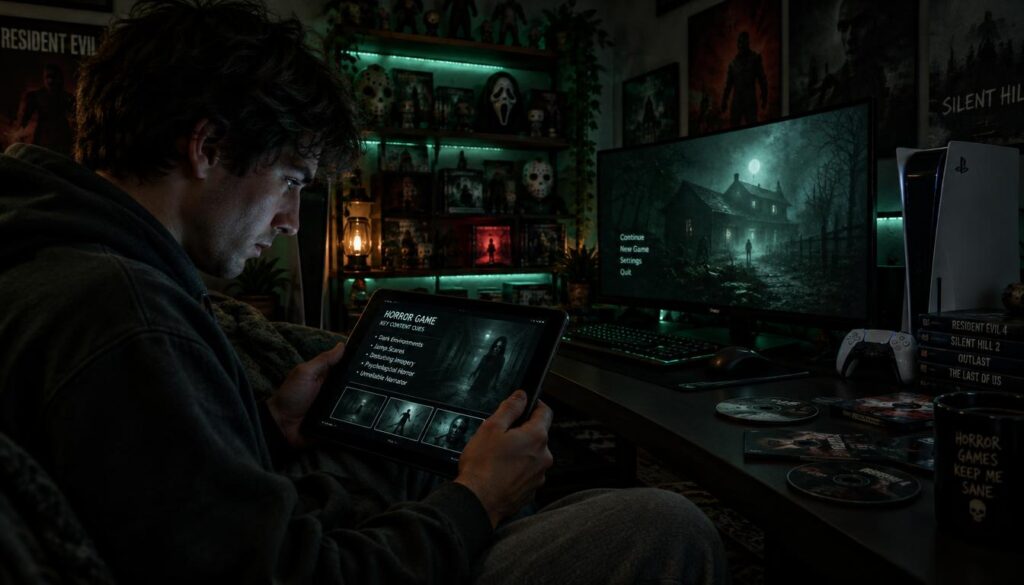
- Look up the ESRB rating and its content descriptors.
- Decide whether pursuit and jump scares are acceptable.
- Consider whether disturbing imagery or body horror is a deal-breaker.
- Choose solo or shared play based on what feels more comfortable.
Content descriptors can flag material that matters to you, such as violence or disturbing images. A scare score cannot replace that check, since two games with similar ratings may feel very different.
Think about the fear itself, not just its intensity. Being chased may bother you more than a sudden sound, while someone else may prefer a clear threat over unsettling images.
Playing alone can increase tension for some people, while a friend can make a difficult moment easier. Choose the setup that helps you enjoy the game, then consider whether a VR headset changes that feeling.
Is a VR Headset Worth It for Horror Games?
A threat can feel different when it fills your field of view instead of a screen across the room. First-person VR can make distance and proximity feel more immediate.
The Walking Dead: Saints & Sinners requires a VR headset. Check headset compatibility and comfort before choosing it, since VR does not suit every player.
Skydance Interactive’s The Walking Dead: Saints & Sinners is a 2020 VR game set in The Walking Dead universe. Its hands-on combat includes guns, knives, broken bottles, and screwdrivers.
That mix of weapons gives each close encounter a physical feel. You are handling tools in the game, rather than only pressing a button from a distance. The headset also makes it easier to notice what is beside or behind you.
Those features can heighten fear, but they can also feel uncomfortable. A headset changes how you see and move through a game, so your comfort with the device matters as much as the horror itself.
Check that your headset supports the game and that you can wear it comfortably for your planned session. If you prefer a shared Halloween activity, you can plan a group session around everyone’s comfort.
How Do You Plan a Horror Game Night With Friends?
Start with your group’s comfort level, not the game with the highest scare factor. A good Halloween session gives everyone a clear way to join, pause, or step away.
Agree on intensity and a break plan before you start. That simple choice helps keep the game fun when a tense moment lands harder than expected.
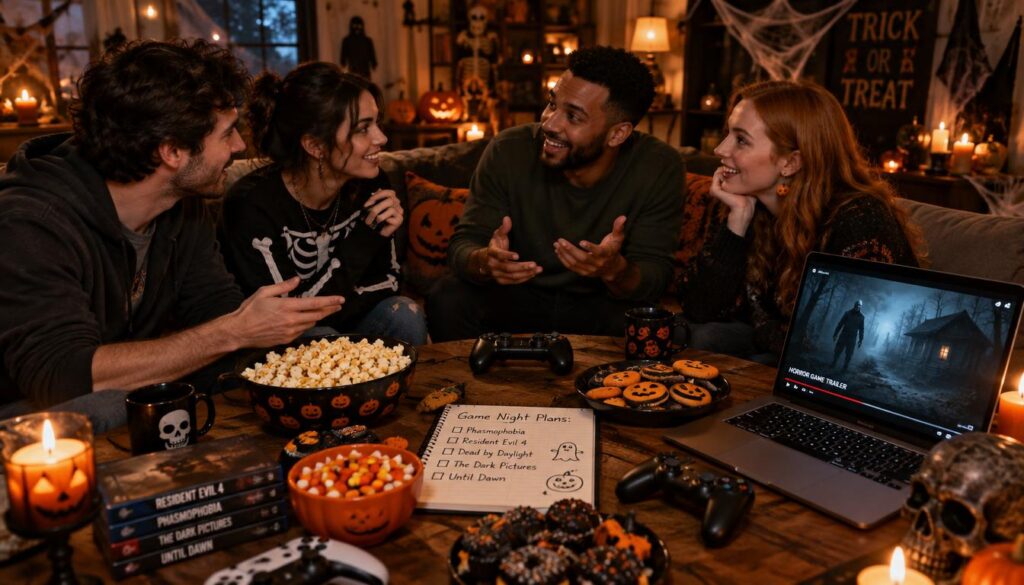
- Agree on the intensity and content everyone is comfortable with.
- Check how many players the game supports.
- Test voice chat and any proximity-chat rules before starting.
- Choose a pause or switch option if someone wants a break.
Player limits shape the group you can include, so check them before inviting everyone. Testing voice chat early also prevents a technical problem from interrupting a tense moment.
Proximity chat needs extra care because your friends may sound far away when the game separates you. Decide how the group will handle that before the first dark corridor.
Laughter with friends can soften fear, but limited visibility and communication can bring the tension back. Your group can set a stop signal or switch to another activity without making anyone explain their choice.
Once everyone agrees on the setup, choose whether you want one evening of play or a longer commitment. Matching the game to your available time can help you avoid stopping at a cliffhanger.
How Can You Tell Whether a Horror Game Fits One Halloween Session?
You have one evening free, but no interest in stopping at a cliffhanger. Check the game’s structure and your stopping point before you settle in.
A game’s total length and the time you have for one sitting are separate things. The way a game saves or divides its goals can matter as much as its overall length.
- Review the game’s chapter or mission structure.
- Look for save points or clearly separated objectives.
- Decide whether you are comfortable pausing during a tense sequence.
- Choose replayable multiplayer if your group wants a flexible stop time.
Chapters and missions can give you natural breaks, while a long sequence may be harder to leave midway. Save points also affect whether you can pause without losing progress.
Some players are fine stopping during a tense scene. Others prefer to reach a clear objective first, especially when the game builds suspense slowly.
A replayable multiplayer session can give a group a more flexible end point. You can finish a round or objective without needing to know how far the whole story goes.
Plan around the time you actually have, not an assumed runtime. Once you know how long you want to play, check which games fit your platform.
Which Horror Games Work on Your Platform, Including Switch?
Confirm the exact platform before getting attached to a recommendation. A game’s listing can vary by edition, console generation, and storefront.
A listed platform does not guarantee every edition or current storefront availability. Check the version tied to your device before making plans.
| Game | Listed platforms | What to verify before choosing |
|---|---|---|
| The Mortuary Assistant | Xbox Series X|S, PS5, PC, Xbox One, PS4, Switch | Confirm the exact store listing for your device |
| Little Nightmares | Xbox Series X|S, PS5, PC, Switch, Xbox One, PS4 | Confirm edition and platform |
| Resident Evil 2 (2019) | Xbox Series X|S, PS5, PC, Xbox One, PS4 | Check your console generation |
| Signalis | Xbox Series X|S, PS5, PC, Xbox One, PS4 | Check the current platform store |
| Until Dawn | PS4 and PS5 | Confirm which version is available on your console |
The table gives you a starting check for Switch and other platforms. It does not replace the exact listing, since a title can have different editions across devices.
Console generation matters for some games, and a version for one PlayStation may not be the one you expect. Check the store page for the device you plan to use.
If your game night depends on a specific edition, confirm that edition before setting a date. After platform fit, subscription users can check whether a title is in their current catalog.
How Do You Find Horror Games on Game Pass?
Subscription users should check the live Game Pass catalog before picking a game night title. The best horror games on Game Pass can change as availability changes.
Catalog availability and subscription terms can change. Check the current app or catalog before planning a session around a specific game.
- Search the current Game Pass catalog for “horror” and individual game titles.
- Filter results by your console or PC.
- Confirm whether a title is included in your subscription tier.
- Check whether a game is leaving the catalog or needs a separate purchase.
Searching by genre can surface options you might miss by title alone. Try individual game names too, since catalog labels may not match the terms you use.
Filter for your device before you pick a game. A title that appears in a catalog may not fit the console or PC you plan to use.
Subscription tiers can differ, so confirm that your plan includes the game. Also check whether it is leaving soon or needs a separate purchase.
These checks make “best horror games on Game Pass” a practical availability question, not a fixed list. Catalog terms can shift, so confirm them in the current app before you invite friends.
Now narrow the choice to one game that fits your mood, group, and platform. A clear pick makes it easier to set a time and get started.
Conclusion
Match the game to the scare style you actually want, not the highest scare score. A tense chase, a slow mystery, and a group session can each make a good Halloween night for different players.
Your comfort, available time, and way of playing should guide the choice. Pick one title that suits those needs rather than trying to satisfy every horror fan at once.
Before you start, check the game’s current platform listing and content rating. Then set up a solo or group session that feels right for you.
FAQ
What’s the most successful horror game?
There is no single answer without a clear measure. Sales, player counts, and cultural influence describe different kinds of success, and they can point to different games. A sales answer needs a defined market and time period, while player counts change across platforms. Cultural influence is broader still, since it includes a game’s lasting place in horror and popular culture.
What scary game is coming out in 2026?
Resident Evil Requiem, Reanimal, and The Mound: Omen of Cthulhu are among the horror games described for 2026. Requiem brings Leon and Grace into a story linked to Raccoon City survivors. Reanimal can be played solo or in co-op, while The Mound supports four-player co-op. Exact launch dates are not given here, so check the game’s current listing for its date.
What are some of the best co-op horror games to play with friends?
Phasmophobia, The Outlast Trials, Lethal Company, and The Blackout Club offer different kinds of teamwork. Phasmophobia lets ghosts react to conversation through voice recognition. The Outlast Trials has groups complete objectives while avoiding villains. Lethal Company uses proximity chat, and The Blackout Club focuses on stealth, where noise can expose the group. Your preferred teamwork style matters more than an objective winner.
What is the no. 1 scariest horror game?
There is no universal number one, because scare tolerance is personal. Alien: Isolation and Amnesia: The Bunker both have a scare factor of 9 in the comparison. That number is a subjective guide, not a formal rating or promise of how you will react. One player may fear a persistent pursuer most, while another may find uncertainty or disturbing images harder to handle.
What’s the scariest multiplayer horror game?
No single multiplayer game is scariest for everyone, and solo play can feel more intense for some players. Phasmophobia’s voice-reactive ghosts can make conversation risky. Lethal Company can also unsettle you when proximity chat leaves teammates hard to hear in dark corridors. Your group’s humor and communication style can soften those moments, or make each separation feel more alarming.
What’s the worst horror game ever?
There is no objective all-time worst horror game. A confusing control system, a story that does not land, or content you dislike can make a game a poor fit for you. Those problems matter more to your experience than a universal ranking. Before choosing, check how the game plays and whether its themes and scare style match what you want.
Which horror game is trending now?
A current trend needs live player or sales data, so a title should not be called the top game without that measure. The 2026 games in this list are recent choices, not a popularity ranking. A new release may attract attention for its series, premise, or play style, but that alone does not show how many people are playing it now.
What’s the most played horror game?
A current answer needs a defined platform and live player-count data. Player numbers shift over time, and one game may lead on PC while another draws more players on consoles. The count may also depend on whether you mean people online at once or total players across a period. Without those limits, “most played” does not point to one stable title.

Pingback: Best Horror Games 2026: Scariest Games Worth Playing This Halloween - GAME INSIDER PRO