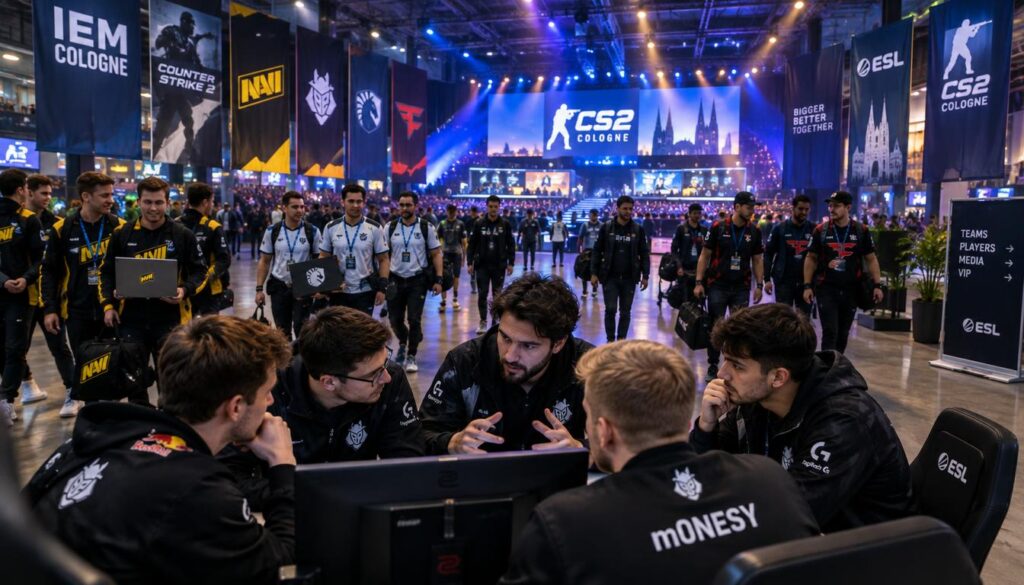
We’ve gathered the key details from the IEM Cologne Major 2026, from its 32-team field to the final result. Valve Regional Standings (VRS) are Valve’s rankings used to determine which teams qualify for the Major. The tournament brought a busy season of Counter-Strike to Cologne, where players competed for a Major title and a share of the prize money.
We cover the teams, format, results, prize pool, venues, and viewing options, with the calendar and outcomes laid out for quick checks. Whether you are tracing one team’s run or confirming a match result, the details below keep the event’s stages distinct. Readers can use the schedule and team sections to quickly find the tournament detail they need.
Key Takeaways
- The event featured 32 VRS-qualified teams.
- Teams entered through Stages 1, 2, or 3.
- Team Falcons defeated FURIA Esports in the final.
- The prize pool totaled $1,250,000.
- Stage 3 and playoffs used separate Cologne venues.
CS2 Major 2026 — Teams, Prize Pool and Schedule: Where Was It Held?
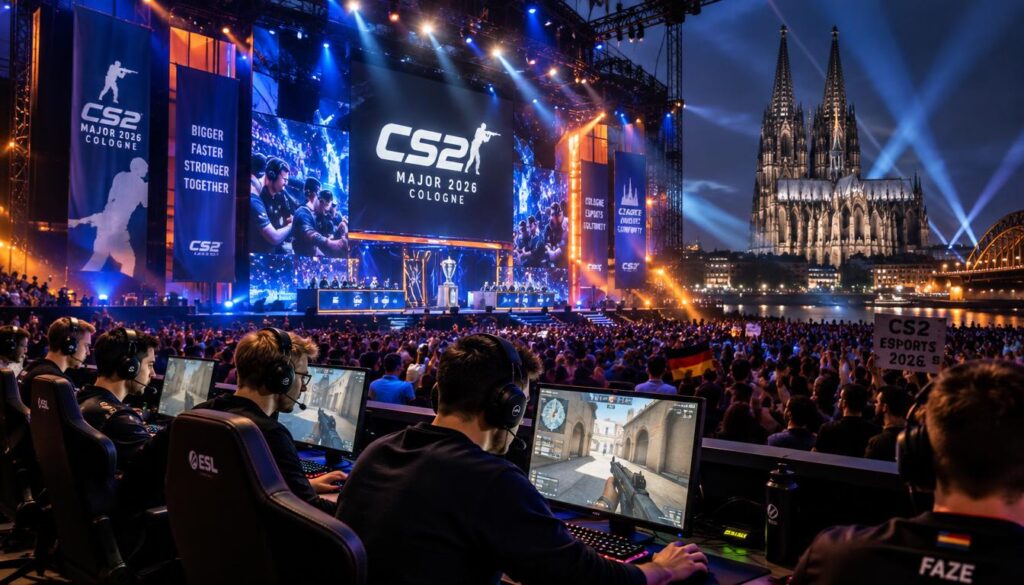
The CS2 Major 2026 was held in Cologne, Germany, from June 2 through June 21. The announced event schedule ran for 20 days in June 2026. The event was the fifth Counter-Strike 2 Major Championship and the 24th Counter-Strike Major overall.
The query about CS2 Major 2026 teams, prize pool, and schedule for 2021 mixes two different years: the Cologne Major took place in 2026, not 2021. Valve Regional Standings rankings determined which 32 teams qualified and the stage where each team entered. Those rankings gave the tournament a field drawn from several regions.
Cologne has a long connection with IEM events, and IEM Cologne Major 2026 brought the city a Counter-Strike title with Major status. Readers new to the game can also explore this free-to-play CS2 overview before following a tournament bracket. The event brought 32 VRS-ranked teams to the German city.
Which Teams Competed at the Cologne Major 2026?
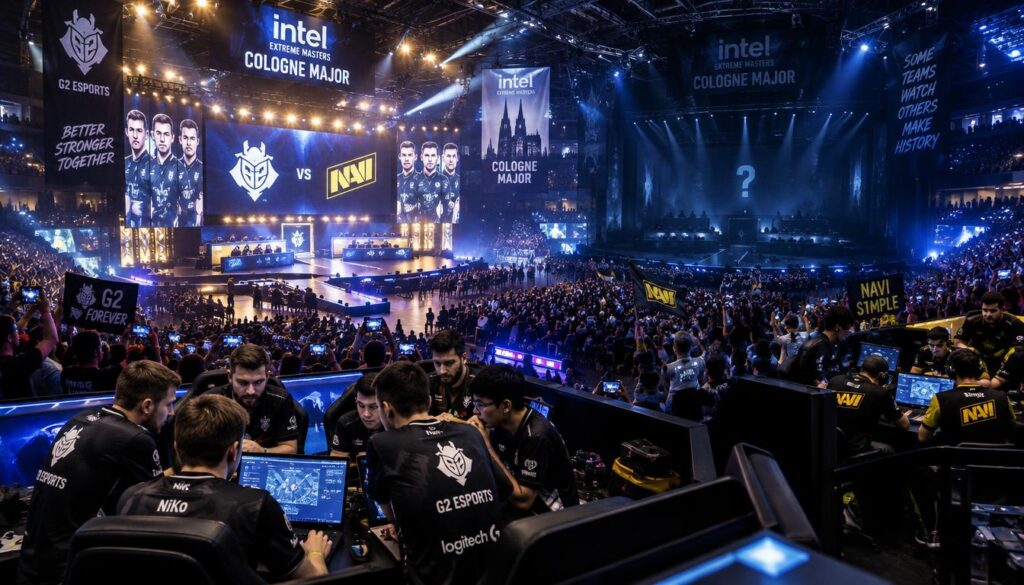
The field was split across three entry stages, with 16 teams beginning in Stage 1 and eight each entering Stages 2 and 3. These groups show where teams entered, not where they finished. Each stage began with a different group of VRS-qualified teams, then Swiss matches determined who advanced or went out.
That structure meant some players started their tournament days earlier than others. Stage 1 entrants faced the longest path, while Stage 3 entrants began closer to the playoffs. The three groups below give us the complete 32-team field without confusing entry stage with a team’s eventual result.
Stage 1 entrants
- GamerLegion
- BIG Clan
- BetBoom Team
- B8 Esports
- HEROIC
- SINNERS Esports
- M80
- NRG Esports
- Sharks Esports
- Gaimin Gladiators
- MIBR
- Team Liquid
- TYLOO
- Lynn Vision Gaming
- THUNDER dOWNUNDER
- FlyQuest
Stage 1 opened the tournament for half of the field. Its teams needed to earn a place in Stage 2 before they could pursue the later rounds.
Stage 2 entrants
- Team Spirit
- Astralis
- G2 Esports
- FUT Esports
- Monte
- 9z Team
- paiN Gaming
- Legacy
These eight teams entered directly at Stage 2, alongside the eight Stage 1 qualifiers. That mix kept the bracket moving while giving early-stage teams a route forward.
Stage 3 entrants
- Team Vitality
- Natus Vincere
- PARIVISION
- Team Falcons
- Aurora Gaming
- MOUZ
- FURIA Esports
- The MongolZ
The eight Stage 3 entrants joined eight teams that had advanced from Stage 2. A team’s starting point shaped its route, but did not determine its finish or its chance to become major champions. Check a team’s entry stage before comparing its route through the tournament.
What Was the CS2 Major 2026 Schedule and Format?
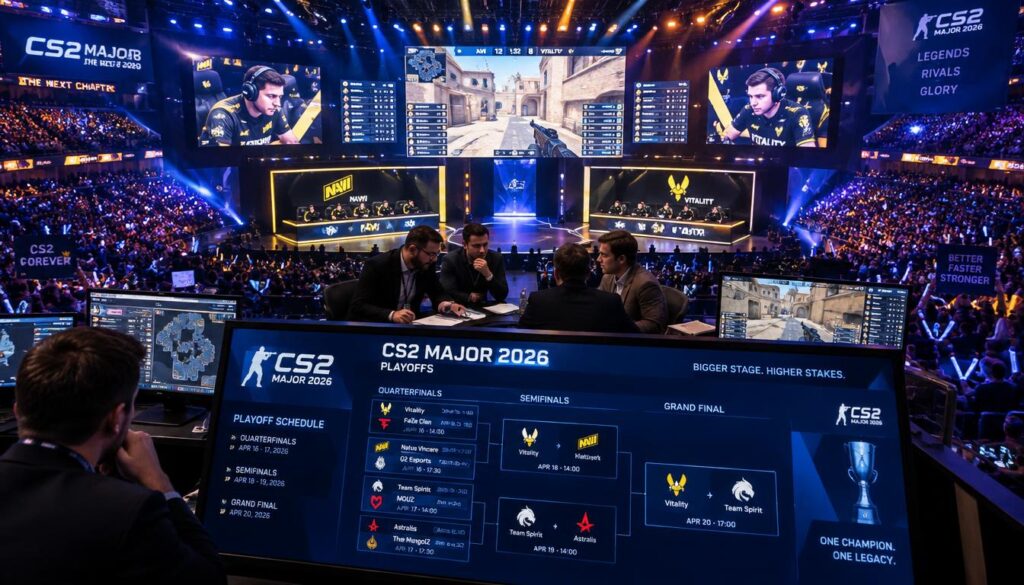
The tournament ran from June 2 through June 21, with three Swiss stages feeding an eight-team single-elimination playoff. Stages 1, 2, and 3 each sent their top eight teams onward. The schedule below gives the dates, field, and match rules for every round.
Stages 1 and 2 used best-of-one matches except for advancement and elimination matches, which were best-of-three. Swiss teams could qualify with a 3-2 record: FlyQuest advanced from Stage 1, and Legacy did so in Stage 2. The CS Major Supplemental Rulebook sets out the Swiss advancement and elimination rules.
| Stage | Dates | Teams or field | Advancement or match format |
|---|---|---|---|
| Stage 1 | June 2-5 | 16 teams | Eight advance; other matches best-of-one, advancement and elimination best-of-three |
| Stage 2 | June 6-9 | Eight qualifiers, eight direct entrants | Eight advance; other matches best-of-one, advancement and elimination best-of-three |
| Stage 3 | June 11-15 | Eight qualifiers, eight direct entrants | All matches best-of-three; top eight reach playoffs |
| Playoffs | June 18-21 | Eight teams | Single elimination; quarterfinals and semifinals best-of-three, final best-of-five |
The CS2 Major 2026 schedule ran in 2026, not 2021, and the Cologne Major 2026 schedule separated the Swiss rounds from the playoff bracket. A Natus Vincere tournament page lists a decisive match against G2 at 19:00 CEST, but gives no match date. The final was the only playoff match scheduled as a best-of-five.
How Was the CS2 Major 2026 Prize Pool Paid Out?
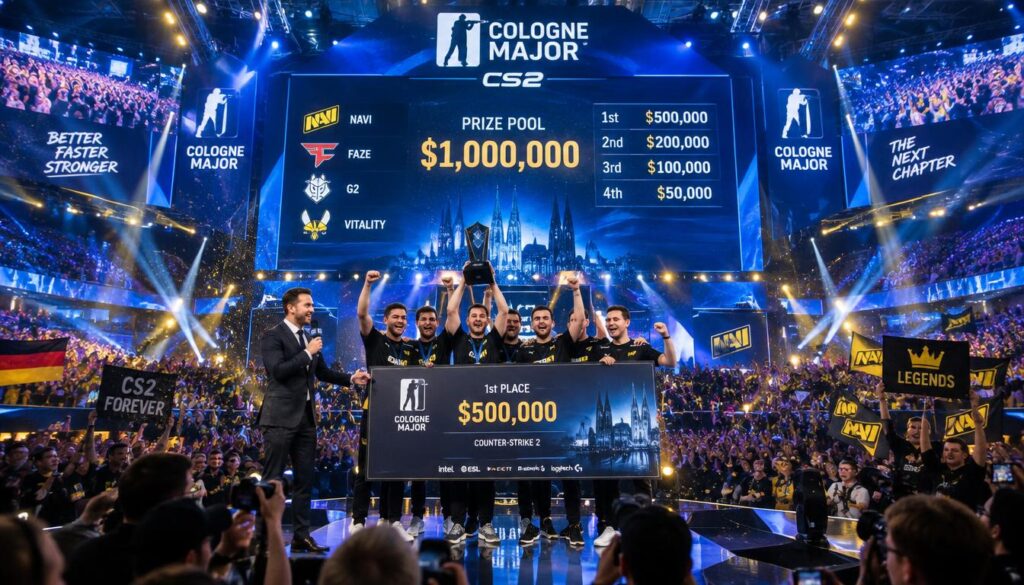
The CS2 Major 2026 prize pool totaled $1,250,000, with $500,000 going to the champions. The runner-up earned $170,000, while third- and fourth-place teams each received $80,000. The remaining prize money went to teams across grouped finishing places.
Fifth through eighth place paid $45,000 per team. The next three bands, ninth through 11th, 12th through 14th, and 15th and 16th, each paid $20,000 per team. Teams in 17th through 19th, 20th through 22nd, and 23rd and 24th each earned $10,000.
| Placement | Payout per team | Detail |
|---|---|---|
| First | $500,000 | Champion |
| Second | $170,000 | Runner-up |
| Third-fourth | $80,000 | Each team |
| Fifth-eighth | $45,000 | Each team |
| Ninth-24th | $20,000 or $10,000 | Ninth-16th: $20,000; 17th-24th: $10,000 |
The prize pools in the lower bands kept a payout available well beyond the playoff bracket. The table groups several places for a faster scan, while the six bands above preserve the exact finishing ranges. A team’s placement determined whether its payout was $45,000, $20,000, or $10,000 below the top four.
Who Won the CS2 Major 2026 Final?
Team Falcons won the CS2 Major 2026 final 3-0 against FURIA Esports. The June 21 grand final gave Falcons their first Major title. Ilya “m0NESY” Osipov earned his first Major MVP award, while Aurora Gaming and Team Spirit shared third place.
Team Vitality entered as the back-to-back Major champion, but Team Falcons eliminated them in the quarterfinals. Team Spirit had a different title to defend: it won IEM Cologne 2025, not the previous CS2 Major. Keeping those two championships separate makes the tournament’s title history easier to follow.
- Falcons claimed their first Major title after a 3-0 grand final win.
- Team Spirit arrived as the IEM Cologne 2025 champion, seeking to defend that event title.
- Team Vitality brought back-to-back Major titles and two consecutive ESL Grand Slam wins, at IEM Rio 2026 and IEM Kraków earlier in 2026. Natus Vincere arrived after winning ESL Pro League Season 23 and IEM Atlanta 2026.
Those credentials set up different storylines for the teams, but only Falcons left with the 2026 Major crown. Team Spirit’s IEM Cologne 2025 title and Team Vitality’s back-to-back Major titles refer to separate championships. The final score and the separate Cologne and Major title histories prevent confusion about which championship each team was defending.
Which Venues and Maps Defined the Cologne Major?
The event used Palladium for Stage 3 and LANXESS arena for its playoffs. LANXESS arena was the playoff venue, not the site of the entire Cologne Major. Both venues were in Cologne, but the later rounds had distinct locations.
Stage 3 matches took place at Palladium. The playoff bracket moved to LANXESS arena, the venue tied to the event’s final rounds. This distinction matters when we compare IEM Cologne events or track where a particular stage was played.
LANXESS arena hosted the playoffs
The 2026 Major playoffs were scheduled at LANXESS arena in Cologne. Stage 3 was held at Palladium, so the two venues covered different parts of the tournament. The venue assignments do not extend to earlier stages.
Seven maps made up the Active Duty pool
The tournament’s seven-map pool consisted of Ancient, Anubis, Dust II, Inferno, Mirage, Nuke, and Overpass. Those maps defined the Active Duty pool for the event, giving teams a clear set of choices for their matches.
Valve replaced Train with Anubis in the Active Duty map pool on January 22, 2026. That change set the pool before the Cologne Major began, rather than during the tournament. The map-pool distinction matters because Anubis took Train’s place before the Major began.
How Could Fans Watch the Cologne Major 2026?
Fans could watch the live broadcast on four ESL Counter-Strike platforms or through broadcast partners. Organizers expected more than 50,000 attendees from over 70 countries. That figure was an expectation for the event, not a confirmed attendance count.
The broadcast reached viewers in more than 20 languages, giving fans around the world several ways to follow the teams and tournament. Online coverage ran across the official ESL Counter-Strike channels listed here:
- Twitch: ESL Counter-Strike
- YouTube: ESL Counter-Strike
- KICK: ESL Counter-Strike
- TikTok: ESL Counter-Strike
- Broadcast partners: live coverage through partner channels
The event’s reach included in-person fans and an international broadcast audience. Organizers’ attendance estimate covered visitors expected from more than 70 countries, while the stream offered a wider choice of languages. Viewers could choose from more than 20 language broadcasts.
Conclusion
Team Falcons’ 3-0 final win over FURIA Esports is the defining result of the Cologne Major 2026. The VRS-based field moved through three stages before the playoffs, where Falcons secured their first Major title.
We can use the team and schedule details here to pin down a specific run, match, or finish. For a result, start with the team or match section; for earnings, check the payout table. Those details make it easier to separate entry stage, final placement, and prize money when comparing teams. We can use the team and schedule details here to pin down a specific run, match, or finish.
FAQ
Did all 32 teams begin in Stage 1?
No, 16 teams began in Stage 1, while eight entered Stage 2 and another eight entered Stage 3. Valve Regional Standings determined the field and its entry-stage groups. That meant half the teams started in the opening Swiss stage, while the other half received direct entry into a later stage. The groups describe starting points, not final placements.
Could teams advance after losing a match?
Yes, teams could advance after a loss if they finished a Swiss stage with a 3-2 record. FlyQuest advanced from Stage 1 with that record, and Legacy did the same in Stage 2. Swiss stages did not eliminate a team after its first loss; teams advanced after three wins or went out after three losses.
Were all matches played at LANXESS arena?
No, Stage 3 matches were held at Palladium, while LANXESS arena hosted the playoffs. The venue distinction applies to those later tournament rounds. LANXESS arena was not the venue for the entire event, and the Stage 3 matches remained at Palladium in Cologne.
Was Team Spirit the defending CS2 Major champion?
No, Team Spirit held the IEM Cologne 2025 title, while Team Vitality entered as the back-to-back Major champion. The teams had different championships to defend. Team Spirit came to Cologne seeking another IEM Cologne win, while Vitality’s status referred to its consecutive Counter-Strike Major titles.
What did Valve Regional Standings determine?
Valve Regional Standings determined the 32-team Major field and the stage where each team entered. Sixteen teams started in Stage 1, eight entered Stage 2, and eight entered Stage 3. The rankings set qualification and entry groups, but did not decide a team’s match results or final placement.