Deadlock is worth trying if you want a deep team game and can accept unfinished systems and invite-limited access. It is most appealing if you enjoy demanding multiplayer games that blend third-person shooting with MOBA strategy. Souls are Deadlock’s in-match currency, earned through Troopers, enemy heroes, and objectives, then spent on upgrades.
The appeal comes with real friction: you must learn a complex match while Valve keeps changing the game. Access also remains limited, so you cannot simply download it from Steam and start playing. This review weighs those tradeoffs and explains what to expect from the current build.
Key Takeaways
- Deadlock has no official release date and requires a playtester’s friend invite.
- Its matches mix third-person shooting with MOBA-style team strategy.
- You earn Souls through Troopers, enemy heroes, and objectives.
- Movement, aim, stamina, and teamwork all shape each match.
- Steam Deck reports point to possible match stuttering and crashes.
Your decision should hinge on whether a steep learning curve sounds like a challenge or a chore.
Deadlock Game 2026: Is Valve’s New Game Worth Playing?
Deadlock has no official release date, and you currently need a friend invite from a playtester to access it. There is no public Steam download, even though the game is described as free-to-play. That matters if you are waiting for a normal release or a public test.
Valve describes Deadlock as an early-development build with temporary art and experimental gameplay. Its invite-limited playtest access is available through friends who already take part. At the time of the Steam-page snapshot, the game was not available there and had no user reviews. You can read a general Deadlock overview for its playtest format and game basics.
Deadlock has no official release date, and access still depends on a playtester’s friend invite.
Valve said in September 2026 that the core game still needed substantial work before polish-focused development could begin. Progression, hero customization, and hideout customization were also areas Valve wanted to adjust through feedback before full release.
The September 2026 City Never Sleeps update added a stylized New York map and six heroes: Nurse Harrow, Rat King, Solomon, Deadman Danny, Baba, and Violet. Players could vote in-game on which hero would arrive first. The update gave players new things to test, but it did not announce a release date.
Deadlock’s existence leaked in 2024, so it was not publicly playable in 2022. If you are asking whether Deadlock was worth playing in 2022, the answer is no public play was available then. Its free-to-play label means no listed purchase price, not open access. For context on the tradeoffs of free and paid games, free access does not always mean anyone can join.
Treat the invite-only build as an ongoing test, not a finished release.
What kind of game is Deadlock?
Deadlock is a third-person shooter built around the team decisions and progression of a MOBA. You aim from behind your hero, while abilities, lanes, and objectives shape how your team advances. Each online match has 12 players, split into two teams of six.
The shooter side puts you in the action
Third-person aiming makes your shots and movement part of every fight. You track enemies across the map, manage space, and use hero abilities with cooldowns. Those abilities can be upgraded during a match, so your choices affect how your hero fights later.
The action draws on the quick movement and team combat found in games such as Team Fortress. Deadlock is not a Team Fortress clone, though. Its shooter feel sits beside a larger system of lanes, upgrades, and shared goals.
The MOBA side gives each match a longer plan
Deadlock borrows broad MOBA ideas from League of Legends and Dota 2, but it plays from a third-person view. Standard enemy waves, called Troopers, move along lanes. Defeating them earns currency for upgrades, while your team presses forward and tries to reach the enemy Patron.
The Patron is the final team objective. Getting there takes more than winning fights: you must decide when to farm Troopers, when to attack, and when to push a lane. A lead can help, but a poorly timed fight can leave your team without enough pressure elsewhere.
Your aim and your map choices happen at the same time. You may need to dodge shots while judging whether your team should stay, rotate, or push. Expect each match to test your aim and your judgment about where the team should spend its time.
How do you play Deadlock’s three lanes?
Start by treating each lane as both a route toward the enemy base and a source of Souls. Troopers turn lane pressure into upgrades, while objectives give your team other ways to build an advantage. Deadlock has three lanes, and farming Troopers yields more Souls than jungling.
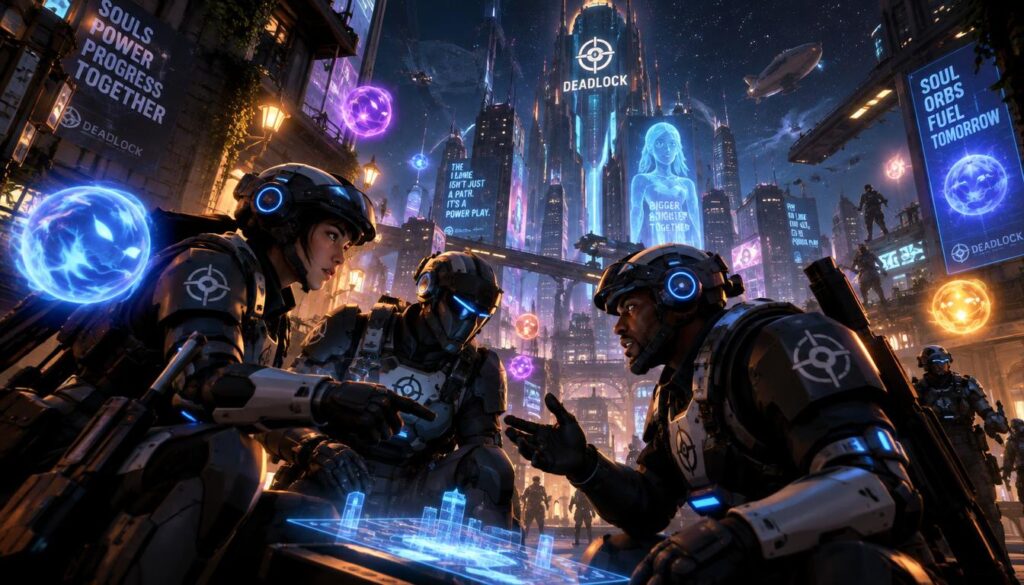
You earn Souls by landing the last hit on a Trooper. That hit releases a green Soul Orb as the Trooper falls, and you can shoot or collect the orb while it descends. These creeps make steady lane farming a key part of your match plan.
Earn Souls and deny them to the enemy
An enemy Trooper releases a red or orange Denial Orb. Shoot it before the enemy team secures it, and you deny those Souls while gaining part of their value yourself. The Denial Orb is different from your green Soul Orb, so watch its color during a busy fight.
| Action | When or what triggers it | Result |
|---|---|---|
| Last-hit a Trooper | Trooper defeated | Green Soul Orb descends for shooting or collection |
| Shoot a Denial Orb | Enemy Trooper defeated | Deny enemy Souls and transfer part of their value to the shooter |
| Clear a neutral camp | Lane pushed and enemy Guardian unsafe | Gain Souls while avoiding the unsafe approach |
| Deliver the Soul Urn | Carry it to the designated enemy-side altar | Significant team-wide Soul injection |
Choose between lane farming, jungle camps, and the Soul Urn
Stay in lane when it is safe, since lane farming yields more than clearing neutral jungle camps. When your lane is pushed up, approaching the enemy Guardian may put you at risk. Jungle camps then offer a fallback, letting you earn Souls without forcing that approach.
The Soul Urn gives your team another objective to contest. Carry it to the designated altar on the enemy side, and your team receives a significant Soul injection. It can reward a coordinated push, but the carrier must reach the altar.
For another view of Trooper farming and lane pressure, read this Deadlock farming guide. When your lane is pushed and the enemy Guardian is unsafe, clear a neutral camp instead of forcing the approach.
What makes Deadlock’s gameplay rewarding, and what might frustrate you?
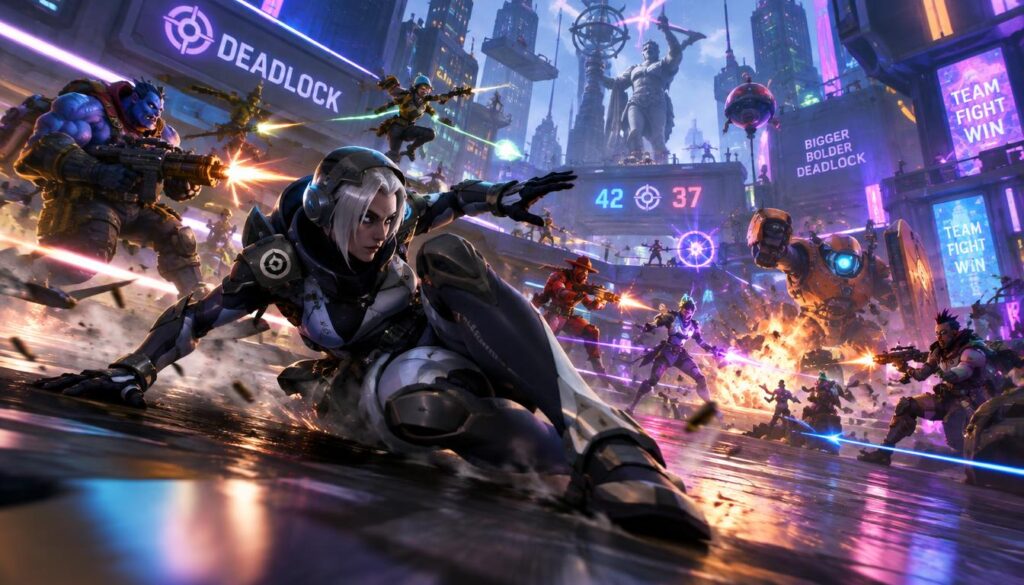
Deadlock’s strongest matches come from combining movement, aim, and timely decisions rather than relying on one skill alone. Fast movement can turn a losing fight, but poor stamina use can leave you exposed. Dashes, double jumps, and slides all use stamina.
Movement and combat reward practice
Vertical movement gives you ways to dodge fire and change your approach. Sliding uses stamina, but it also gives you infinite ammo, creating a clear reason to practice its timing. Heroes can use normal or strong melee attacks, and a well-timed parry can stop an incoming hit.
Roguelite-style power-ups can also change your build during a match. A power-up may push you toward a different approach, so sticking to your starting plan can waste its value. Learning to adjust makes close matches feel less scripted.
The learning curve can punish rushed decisions
The same tools can punish you when you rush. Spend too much stamina, and an escape or engage may be out of reach. Overextend alone, and your teammates may arrive too late to help. Even strong aim cannot fix every bad team decision.
In September 2026, City Never Sleeps helped Deadlock reach an all-time peak of more than 228,000 concurrent players. SteamDB-tracked data later recorded 262,145 concurrent players. A peak counts players at one moment, not current daily players, and it cannot prove game quality.
Use this short practice checklist to build better habits:
- Conserve stamina for a planned escape or engage.
- Try sliding while firing to learn its timing.
- Practice parry timing against incoming attacks.
- Adjust your build to the power-ups you acquire.
A high concurrent-player peak signals strong interest, but it cannot tell you whether you will enjoy the learning curve.
What can Deadlock’s hero roster and win rates tell you?
Deadlock’s roster is broad, but an undated win-rate list is only a rough snapshot, not a dependable hero ranking. Forty-four heroes leave room for varied playstyles, and each has at least four unique abilities. Standard-match heroes can hold up to nine items, with up to three extra slots from destroying Walkers.
The Deadlock hero roster includes characters with distinct abilities and item choices. Those options can support different roles, but they also make one hero harder to compare with another. Your comfort with a hero’s abilities matters as much as a listed percentage.
The rates below show a few listed leaders. The page gives neither a reporting date nor a sample size, so treat each number with care.
| Hero | Listed win rate | Data caveat |
|---|---|---|
| Graves | 57% | Date and sample size unspecified |
| Rat King | 57% | Date and sample size unspecified |
| Paige | 56% | Date and sample size unspecified |
| Haze | 54% | Date and sample size unspecified |
| Kelvin | 54% | Date and sample size unspecified |
The listed win rates also put Seven at 54%, Ivy at 53%, and Baba and Dynamo at 52%. Without dates or sample sizes, those numbers cannot show whether a balance change shifted the results. A strong rate also cannot promise that a hero will fit your style.
A separate 2026 match-data analysis tracked hero rates across five patches from January to April. It shows why a dated window matters: Seven led its sampled periods, while Holliday’s rate rose between patches. Those results describe past match data, not a permanent ranking.
Use three checks when you judge a hero statistic:
- Check the statistic’s reporting date.
- Check its sample size.
- Compare it with your comfort using the hero’s abilities.
The roster and item limits can help you see how much room each hero has to grow. Choose a hero whose abilities you want to practice, rather than treating a single percentage as a guarantee.
What should you expect from Deadlock on Steam Deck?
One Steam Deck player reported an average of 50 FPS in the lobby on low or disabled settings, but also described severe stuttering and occasional match crashes. The lobby result does not predict match performance, where the same player had problems. This is one player’s report, not a benchmark or a representative test.
The report gives you a mixed picture rather than a clear performance rating. A 50 FPS lobby may feel playable, but a lobby has fewer demands than a full multiplayer match. Severe stuttering can disrupt aim and movement, while crashes can interrupt play entirely.
Low settings did not prevent those match problems for that player. Your experience may differ, but one report cannot show how the game runs across Steam Deck systems or later builds. Do not assume that lowering every setting will make matches stable.
A playable lobby does not guarantee stable matches, especially when the only report also describes stuttering and crashes.
Treat that report as a reason to test the current build yourself, not as a reliable performance guarantee.
Conclusion
Deadlock is worth a look if you want a demanding shooter-MOBA hybrid and do not mind learning while the game is still changing. Its mix of movement and team strategy may suit you if you like complex multiplayer games. Its unfinished systems may frustrate you if you want a settled experience.
Ask an existing playtester for an invite if you want to try it. Test performance on your own hardware, then judge the game by your own matches. Ask a playtester for an invite, then decide after a few matches whether its mix of movement and strategy keeps you coming back.
FAQ
Is Deadlock still in development?
Yes, Deadlock is still in development. Valve said in September 2026 that substantial work remained on the core game before development could shift toward polish. Valve also wanted to adjust progression, hero customization, and hideout customization based on feedback. That means the current build can still change in major ways before full release.
Does Deadlock run well on Steam Deck?
One Steam Deck player reported 50 FPS in the lobby with settings low or off, but also reported severe stuttering and occasional match crashes. That single experience is not a benchmark, so it cannot predict performance across devices. A lobby result also does not show how smoothly a full match will run.
How do you get access to Deadlock?
You need a friend invite from someone who is already a playtester. Deadlock does not have a public Steam download for players to join on their own. Its free-to-play description does not change that access rule. If you want to try it, ask an existing playtester whether they can invite you.
How many heroes are in Deadlock?
The Deadlock wiki lists 44 playable heroes. Each hero has at least four unique abilities, which gives you many styles to try. Standard-match heroes can also hold up to nine individual items, with up to three extra slots earned by destroying Walkers. Those systems give each match room to shape your hero’s build.
Is Deadlock free to play?
Deadlock is described as free-to-play, but access remains limited to friend invites from playtesters. That means you cannot treat the free-to-play label as an open invitation to download and play. It describes the game’s price model, not its current availability. There is also no official release date for a public launch.