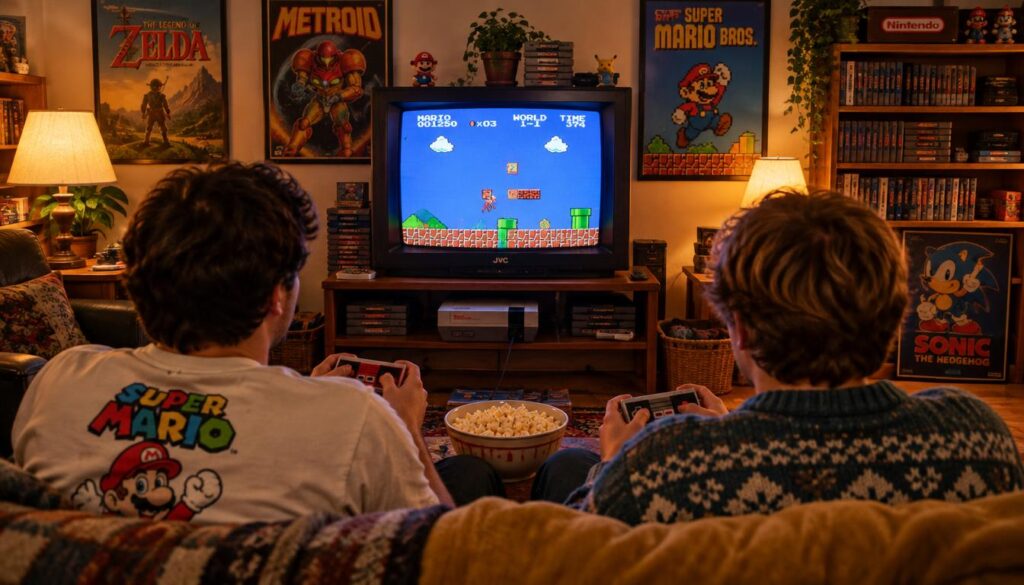
A well-designed classic can still feel immediate the first time we pick it up, even decades after release. The right game can make a spare hour feel lively, whether we are learning its rules or returning to familiar ground.
Our Best Retro Games Still Worth Playing in 2026 guide offers practical picks that remain enjoyable, not just important to gaming history. We cover arcade play, platforming, adventure, role-playing games, action, and multiplayer.
Newcomers and returning players are both welcome. The best starting point depends on the kind of play we want, the time we have, and the experience we hope to get. The right first pick is the one whose core activity sounds fun to us today.
Key Takeaways
- Choose a game for its play style, not only its age.
- Pac-Man and Tetris suit quick arcade and puzzle sessions.
- Super Mario World offers a friendly platforming start.
- Adventure and RPG picks reward players who enjoy discovery.
- Check the edition and controls before starting a game.
How We Choose the Best Retro Games Still Worth Playing in 2026
A game can be old enough to count as retro and still feel frustrating to play. We favor responsive play, clear rules, fair challenge, and reasons to return.
A classic earns its place through good play today, not age or reputation alone.
We use those standards to judge retro games by how they work now. Nostalgia can add meaning, but it cannot fix confusing design or sluggish controls.
What counts as retro?
There is no single cutoff for a retro game. People often mean games from the 1970s through the early 2000s, or titles about 15-20 years old.
Age gives us a starting point, not a final answer. A game from the edge of that range can still feel modern, while an older one may feel rough.
BioShock is a useful boundary case. Released Aug. 21, 2007, it earned a Metascore of 96, Metacritic’s numerical summary score for a game.
A high score can point to broad praise, but it cannot prove every player will enjoy a game. Taste, control style, and pacing still matter.
What makes an older game hold up?
Good design lets us understand the goal and trust the controls. Challenge should rise because we need better timing or judgment, not because the rules change without warning.
We look for four signs that a game can reward players decades later:
- Responsive controls that react as expected.
- Understandable goals that guide play.
- Challenge that follows the game’s rules.
- Replay value through mastery, secrets, or multiplayer.
These tests work across genres, from an arcade score chase to a story-led adventure. We should judge a classic by the experience it offers now, not by its reputation alone.
Which Retro Titles Are Most Popular With U.S. Players?
Super Mario Bros. is the highest-ranked title in YouGov Ratings’ third-quarter 2026 U.S. list. It holds No. 1, with reported figures of 90% and 63%.
The ranking offers a snapshot of familiar games, rather than a test of how well each one plays today. The two figures below are reproduced without assigning them meanings.
| Title | Rank | First reported figure | Second reported figure |
|---|---|---|---|
| Super Mario Bros. | No. 1 | 90% | 63% |
| Mario Kart 8 | No. 4 | 76% | 52% |
| Super Mario Odyssey | No. 6 | 74% | 49% |
| Sonic the Hedgehog | No. 9 | 81% | 49% |
| The Legend of Zelda | No. 10 | 75% | 48% |
Video games reach players across ages and backgrounds. The ESA reported that 205.1 million Americans ages 5 to 90 regularly played in 2025.
The ESA’s online survey ran February 11-25, 2025, and included 5,000 respondents. The average U.S. player was 36 and had played for 18 years.
U.S. players were 47% women and 52% men. Sixty percent of U.S. adults played weekly, including 49% of baby boomers and 36% of the Silent Generation.
That participation count shows a large player base, but one report cannot prove gaming is growing or shrinking over time. Popularity can help us find a starting point, but the best choice still depends on the kind of play we enjoy.
What Makes Arcade and Puzzle Classics Last?
A maze, a handful of rules, and a rising challenge can make a quick session hard to put down. Pac-Man suits short arcade sessions, while Tetris is our strongest pick for repeatable puzzle play.
Both games show how a small set of rules can create plenty of decisions. Their simple starts leave room for skill to grow.
Pac-Man turns a simple maze into a challenge
Released in 1980, Pac-Man asks us to move through a maze, collect pellets, and avoid ghosts. The goal is easy to grasp before the first turn.
Chasing a higher score depends on choosing routes well. A corridor that looks safe can become a trap when ghosts close in.
That clear loop makes the arcade game easy to try in a short break. Each run gives us another chance to read the maze and improve our route.
Tetris makes a small rule set endlessly replayable
Tetris arrived in 1985 and builds its pressure from falling pieces. We fit each shape into the stack, then make quick choices as the pace rises.
The basic rules stay small, but the board keeps changing. One careless gap can limit our options, so good placement matters more as play continues.
Tetris sales across its different versions reached 520 million by 2022. That total combines releases across versions, so it is not a like-for-like comparison with one game release.
We can choose Pac-Man for route planning and a quick arcade score chase. Tetris is better when we want a puzzle loop that invites repeated attempts. For an easy first test of arcade design, play a short Pac-Man session and see whether route planning pulls us back in.
Which Platformers Still Reward Every Run?
Super Mario World is our safest starting point for precise, exploratory 2D platforming. Its expressive level design, secrets, and responsive movement make each run easy to read.
Platformers differ in what they ask from us. Mario rewards careful jumps and exploration, while Sonic makes speed and momentum part of the challenge.
Super Mario rewards exploration and precision
Super Mario World is a strong choice when we want to study a level as we play. Hidden paths give us a reason to look beyond the shortest route.
Its movement feels direct, so a missed jump often points to timing we can improve. That balance makes it a welcoming retro game for players learning platforming.
Super Mario Bros. first appeared in 1985 and has reported sales of 58 million copies. That figure belongs to Super Mario Bros., not Super Mario World.
Sonic makes momentum part of the challenge
Sonic the Hedgehog 2 suits players who enjoy momentum and alternate routes. Its stages reward speed, but rushing can make hazards harder to read.
The first Sonic the Hedgehog was released in 1991 and has reported sales of 40 million copies. The series asks us to learn how movement changes with speed.
In YouGov Ratings’ third-quarter 2026 U.S. list, Sonic the Hedgehog ranked No. 9, with figures of 81% and 49%. Sonic the Hedgehog 2 ranked No. 16, with 77% and 48%.
Later Mario releases offer different ways to revisit the formula
Super Mario Bros. Wonder ranked No. 14 in the same U.S. list, with figures of 72% and 48%. Super Mario Run ranked No. 20, with figures of 74% and 45%.
Those rankings show popularity, not a fixed order of quality. The games offer different ways to play, so the better fit depends on our taste.
Choose Mario for deliberate jumps and secrets, or Sonic 2 when learning speed and momentum sounds more rewarding.
Which Adventure Games Still Make Exploration Worthwhile?
For a classic built around exploration, A Link to the Past is our first recommendation. Choose it for dungeons and puzzles, or Super Metroid for a map that opens with new abilities.
Both games make discovery part of progress. They differ in how they lead us through their worlds.
A Link to the Past builds a world worth exploring
The Legend of Zelda: A Link to the Past came out for SNES in 1991. Its dungeons give players clear goals, puzzles, and places to test new items.
A two-world structure adds another layer to the adventure. Exploring one place can change how we understand another, making the map feel connected.
Choose this game when we want a steady path through dungeons, with puzzles along the way. Its clear stages make a large adventure easier to follow.
Super Metroid rewards curiosity and backtracking
Super Metroid was released for SNES in 1994. Its connected map changes as we find abilities that open blocked routes.
We often return to places that seemed closed before. A new tool can turn a familiar corridor into a useful path, which makes backtracking part of discovery.
The Legend of Zelda ranked No. 10 in YouGov Ratings’ third-quarter 2026 U.S. list, with figures of 75% and 48%. That result gives popularity context, not a rating for A Link to the Past itself.
A Link to the Past emphasizes dungeons and puzzles, while Super Metroid asks us to revisit places with new tools. Choose a dungeon-focused adventure for a clear sequence of challenges, or Super Metroid for a map that gradually reveals its connections.
Which Retro RPGs Deliver the Strongest Stories?
Chrono Trigger is our clearest recommendation for a first classic RPG because its adventure keeps moving. Choose among these games by pace, cast, or presentation, not by a claim of one universal winner.
Each role-playing game offers a different path into the genre. Their stories and characters suit different kinds of players.
Chrono Trigger is the approachable time-travel adventure
Chrono Trigger came out for SNES in 1995. Its time-traveling story moves briskly, making it an approachable starting point for a classic JRPG.
The shifts between eras keep the adventure moving without asking us to learn a complicated world first. We can pick this game when pace matters most.
Its clear direction also helps newcomers settle into the genre. The story gives us a reason to keep going from one event to the next.
Final Fantasy VI centers an ensemble cast
Final Fantasy VI was released for SNES in 1994. It centers an ensemble cast, giving several characters room to shape the wider conflict.
Its tone is more serious, with a story that draws on the cast’s different struggles. Choose it when we want character relationships to carry much of the experience.
The larger cast gives the story a different feel from a single-hero adventure. We can follow how each person responds to the conflict around them.
Final Fantasy VII marks a shift to cinematic 3D
Final Fantasy VII arrived on PlayStation in 1997. Its 3D presentation and story-led structure show a shift from the look of 2D RPGs.
That change may appeal to players curious about how the genre moved into cinematic scenes. It remains a distinct option for those who value presentation as much as pace.
Each game suits a different first step into classic role-playing games. Start with Chrono Trigger for pacing, Final Fantasy VI for an ensemble, or Final Fantasy VII for a landmark 3D presentation.
Which Action Games Still Feel Sharp?
For a direct hit of classic shooter action, we recommend the 1993 DOOM. Its fast movement, weapon choices, and maze-like levels keep combat at the center.
The original DOOM and the 2016 reboot are separate games from different periods. We should not treat the reboot as the original release.
DOOM makes movement and combat the focus
DOOM makes us move quickly through levels while choosing weapons for the threat ahead. The maze-like spaces reward attention as much as aim.
Its action feels direct because combat and movement drive the experience. Players who want a clear shooter loop can start with the original game.
The franchise later received a reboot in 2016. That release revisits the name, but it does not replace the original 1993 game.
BioShock is a later boundary case
BioShock offers a different kind of action, with a stronger narrative atmosphere. Its 2007 date places it near the later edge of common ideas about retro games.
Metacritic lists BioShock with a Metascore of 96 and a date of Aug. 21, 2007. The score can help us gauge critical regard, but personal enjoyment still depends on taste.
Players who want fast combat can begin with the original DOOM. Those who want story and atmosphere alongside action can try BioShock. Pick the original DOOM for immediate combat, and try BioShock when story and atmosphere matter as much as action.
Which Fighting and Multiplayer Classics Hold Up?
Street Fighter II is our pick for learning the fundamentals of a traditional fighting game. Its practice rewards timing, spacing, and character-specific moves.
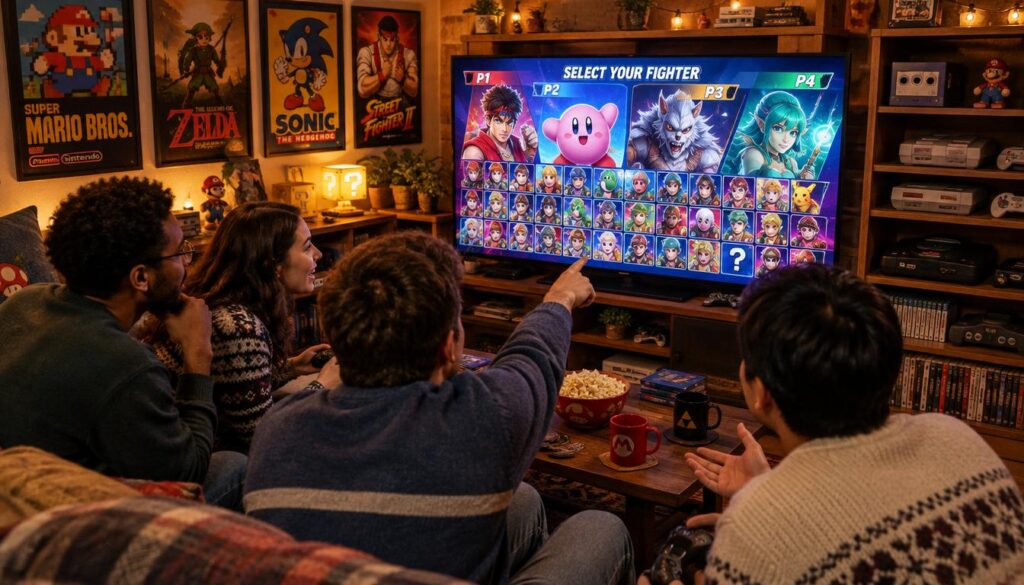
For a group, Super Smash Bros. offers a less conventional arena fight and a larger cast. Mortal Kombat suits players who prefer a more theatrical style.
Street Fighter II rewards practice and timing
Street Fighter II was released in 1991. We learn to judge distance, time attacks, and use moves that fit each character.
Those skills make matches engaging for players who enjoy practice. A careful move can matter more than pressing buttons as fast as possible.
Mortal Kombat makes combat more theatrical
Mortal Kombat gives fighting a more theatrical presentation. It ranked No. 19 in YouGov Ratings’ third-quarter 2026 U.S. list, with reported figures of 84% and 46%.
The figures below appear without labels because their meanings are not assigned here. The ranking offers popularity context, not a measure of match quality.
Super Smash Bros. turns a familiar cast into a party fight
Super Smash Bros. brings a larger cast into an arena fight that works for groups. It ranked No. 18 in the same U.S. list, with figures of 72% and 47%.
Its format can suit a casual session better than a traditional one-on-one match. Players can learn the controls together and find characters they like.
| Game | YouGov rank | First figure | Second figure |
|---|---|---|---|
| Street Fighter II | not listed here | not listed here | not listed here |
| Mortal Kombat | No. 19 | 84% | 46% |
| Super Smash Bros. | No. 18 | 72% | 47% |
For a first group session, choose the game whose controls and character styles everyone can learn quickly.
Which Consoles and Disc-Based Games Are Best to Revisit?
The best system depends on whether we want cartridges, disc-based adventures, or a ready-made collection. Match the game to its original system, then check which format a console can run.
These starter picks connect a system with a familiar game and a useful genre. They are a practical shortlist, not a complete catalog.
Best retro games for each system
| System | Starter game | Genre | Why it fits |
|---|---|---|---|
| NES | Super Mario Bros. | Platformer | Clear, direct stages |
| SNES | A Link to the Past | Adventure | Dungeons and puzzles |
| Sega Genesis | Sonic the Hedgehog 2 | Platformer | Momentum and routes |
| PlayStation | Final Fantasy VII | RPG | Story-led 3D presentation |
| Nintendo 64 | GoldenEye 007 | Shooter | First-person action |
Which disc-based games are worth revisiting?
Final Fantasy VII and GoldenEye 007 are examples of disc-based games worth revisiting. “Disc-based” describes the original format, not guaranteed present-day availability.
The hardware and the version both matter. A modern device may offer a collection instead of a way to use the original disc.
What to expect from a 2025 retro game console
A 2025 retro game console may mean original hardware, a mini console, or a modern device that runs licensed collections. The catalog and format can differ across these choices.
Wii Sports sold nearly 83 million copies, making it a notable example of a single-platform release. It came out for Wii in 2006, so it is a later Wii title, not one of our retro picks.
Minecraft had sold over 425 million copies as of 2026, a figure for the game across platforms. Tetris reached 520 million across versions by 2022, a contested total that combines different releases.
A single-platform figure, an overall game total, and a combined version total do not measure the same thing. Before choosing a console, check the games it actually includes and whether those titles match the format we want.
How Can We Play Retro Games on Modern Devices?
We usually do not need an original console to try a classic, but we should verify the edition first. Collections, subscriptions, remasters, ports, and original hardware each offer a different experience.
Modern game collections can bring several older games to one device. The best fit depends on the games we want and the controls we prefer.
Collections and subscriptions
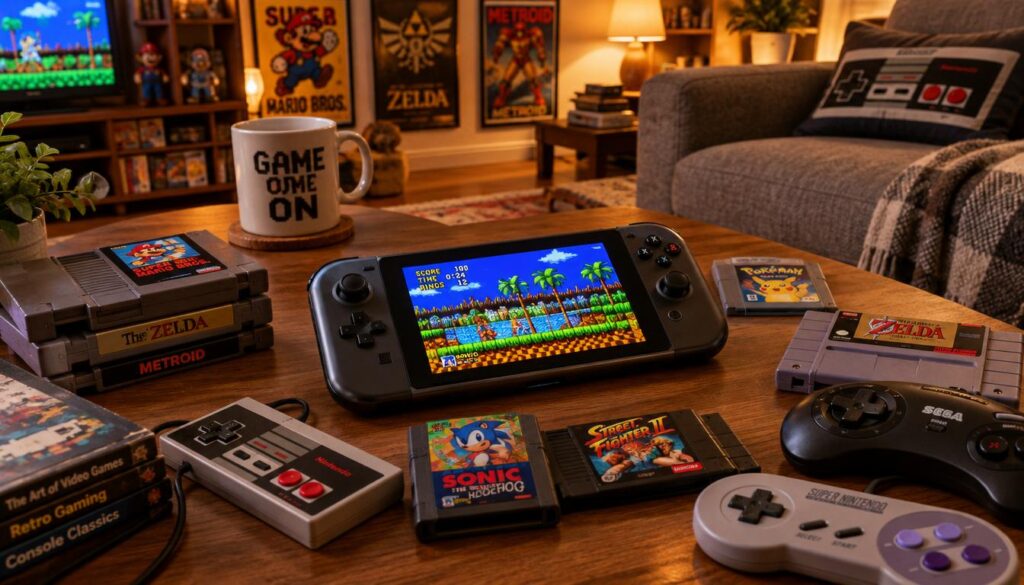
Nintendo Switch Online includes NES and SNES libraries. Capcom Arcade Stadium and Mega Drive / Genesis Classics are other examples of modern collections.
These options can make classic games convenient to try, but catalogs and subscription terms can change. We should check the current library and whether access requires a subscription.
Players comparing phone games can also read our mobile games worth your time guide. It covers modern games, not ways to play retro titles.
Remasters, ports, and original hardware
A remaster updates an older game and may improve its display or controls. Those changes can also alter the original presentation, so the new edition may feel different.
A port moves a game to another system. It can feel awkward when its design expects a different input method, such as a controller instead of touch controls.
Before we start, we can use this short checklist:
- Confirm the exact edition.
- Check the supported device.
- Verify controller support.
- Check whether access depends on a subscription.
Our Android mobile game guide also considers session length and phone controls. Confirm the platform, controls, and access terms before starting a playthrough.
What Should We Know Before Collecting Original Copies?
For collectors, the exact packaging can matter as much as the game inside. Condition, seals, grading, and rarity can all affect interest in an original copy.
A familiar title may have many physical versions. Small differences in its box or seal can separate one release from another.
Condition, seals, and grading
We should inspect the item itself instead of relying on a listing title. A careful check can help us compare the offered copy with the one we mean to collect.
Use four basic checks before buying an original copy:
- Confirm the exact release.
- Inspect the box and cartridge condition.
- Check seal and label details.
- Compare the grade with the item offered.
Grading gives a copy a condition rating, but details still matter. The seal, box, label, and cartridge may each have features that change collector interest.
Why one auction price is not a normal price
A sealed Super Mario Bros. NES copy sold at auction for $100,150, a record for a graded game at the time. Its box received a Wata Games grade of 9.4, described as near mint, and its sticker seal earned an A++ rating.
The report described that copy as the only known one with a sticker seal. Wata Games said sticker-sealed packaging appeared in New York City and Los Angeles test markets in 1985 and early 1986.
A different copy with a hangtab and no sticker seal sold for $30,000. That version was one of a dozen, which still makes it unusual.
Those sales reflect specific copies and details, not a normal price for every cartridge. Treat a one-of-a-kind graded copy as an exception, not as a price guide for a standard cartridge.
Which Retro Game Should We Start With?
For most newcomers, Super Mario World is a friendly first choice because its goals and controls are easy to grasp. Our best starting game depends on the genre and kind of session we want.
These five choices are starting points, not a ranking of the whole medium. Each gives us a clear way into a different style of play.
Choose a game that fits the session we want, then give it enough time to learn its rhythm.
- Pac-Man for quick arcade sessions.
- Tetris for repeatable puzzles.
- Super Mario World for platforming.
- A Link to the Past for exploration.
- Chrono Trigger for a story-led RPG.
Pac-Man, released in 1980, is a quick entry point for arcade play. Super Mario World and A Link to the Past both came out in 1991, while Chrono Trigger arrived in 1995.
Super Mario Bros. leads the cited U.S. popularity ranking in 2026. That makes it a familiar choice, but popularity does not decide which game suits us best.
We can choose a familiar title or a different genre that better fits our mood. Pick one game that fits the kind of session we want, then give it enough time to learn its rhythm.
Conclusion
A classic is worth revisiting when its basic play still feels rewarding, not just familiar. Age and nostalgia can shape our connection to a game, but enjoyable play gives it lasting value.
We can start with the genre that sounds most appealing, then check the edition and controls before playing. A small first step makes it easier to see whether the experience fits our time and taste.
Choose one title that fits our mood, check the controls, and start with a single session.
FAQ
Which game is very popular in 2026?
Super Mario Bros. ranked No. 1 in YouGov Ratings’ third-quarter 2026 U.S. list, with reported figures of 90% and 63%. Those figures are presented without assigning them meanings here. The ranking shows broad popularity, but it does not tell us which game will suit a particular player. Play style and personal taste still shape the best choice.
What Nintendo game sold for $100,000?
A sealed Super Mario Bros. NES copy sold for $100,150 at auction. It was a rare graded copy, not a typical sale or a normal price guide for other cartridges. Its box received a 9.4 grade, and its sticker seal received an A++ rating. The reported rarity and packaging help explain why that one copy drew unusual interest.
Do Gen Z play retro games?
Gen Z players may play retro games, but the ESA’s 2025 report does not give a Gen Z-specific figure. It says 205.1 million Americans ages 5 to 90 regularly played video games. That wide age range shows that gaming reaches many generations, but it cannot tell us how many Gen Z players choose older games in particular.
Is 27 too old for gaming?
No, 27 is not too old for gaming. The reported average U.S. player age was 36 in 2025, and the average player had been playing for 18 years. People can start or continue playing at many ages. A game’s controls, pace, and subject matter matter more to enjoyment than a player’s age.
Is it true that 70% of Americans play video games?
The ESA reported that 60% of U.S. adults played video games every week in 2025. That is a weekly adult measure, not a claim that 70% of all Americans play. The report also counted 205.1 million regular players ages 5 to 90. Those figures use different groups and measures, so they should not be treated as interchangeable.
Is gaming dying or growing?
Gaming had a large U.S. player base in 2025, with 205.1 million Americans ages 5 to 90 playing regularly. That single-year participation figure does not establish whether gaming is growing or shrinking over time. A trend needs figures from multiple periods using the same measure. The report does show that video games reach players across a wide age range.
Are 51% of gamers female?
The ESA reported that U.S. players were 47% women and 52% men in 2025. That report does not support a 51% figure for women. The figures describe the reported player population and should not be swapped for another group or measure. They also should not be treated as a count of every person who plays games.